
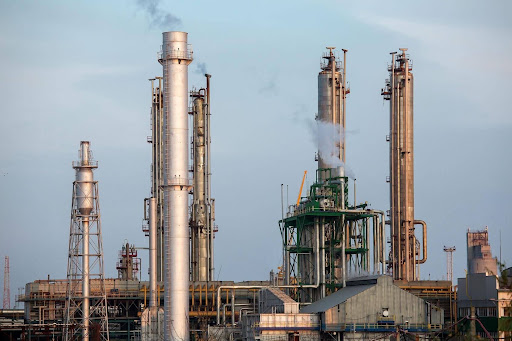
Industrial Air Filtration Systems at a Glance
Industrial air filtration systems control plant emissions by removing liquid droplets, aerosols, and particulates from process gas streams before they reach the atmosphere or downstream equipment. Depending on the contaminant, that means mesh pad or fiber bed mist eliminators for liquid droplets, tower packing and scrubbers for soluble gases, drift eliminators for cooling tower carryover, and liquid coalescers for phase separation.
The main takeaway: the right equipment is the one that fits the droplet size, gas load, and process chemistry of the stream, identify those first, then narrow further by material and maintenance needs. Kimre, Inc. manufactures mist eliminators and air pollution control products for industrial plants across the power generation and chemical processing industries, so one manufacturer can specify and build the full system rather than piecing it together from separate vendors.
Choosing the right industrial air filtration systems and pollution control equipment for a process plant starts with understanding what is actually moving through the gas stream. A stream carrying fine sulfuric acid mist behaves nothing like one carrying ammonia and dust from a fertilizer granulator, and the equipment that captures each has to be selected accordingly.
This guide walks through the core technologies used across mist elimination, gas absorption, drift control, and liquid-liquid separation, all four of which Kimre™ Clean Air Technology engineers for industrial plants, and shows how droplet size, gas velocity, and material compatibility drive equipment selection for a given process. It also covers how staged system design and material choice affect service life in corrosive or high-temperature service, and where each technology fits within a broader air pollution control strategy.
Why Industrial Air Filtration Systems Matter in Process Plants
Process gas streams rarely arrive clean. Reaction, evaporation, cooling, and scrubbing steps all generate liquid droplets, aerosols, and particulates that have to be removed before the gas reaches a stack, a downstream compressor, or open air. When mist elimination is inadequate, the result is increased entrainment of hazardous or corrosive droplets that carry over into downstream equipment, which compromises both equipment protection and emissions compliance at once.
Industries That Depend on This Equipment
Kimre™ Clean Air Technology serves plants across a wide range of industrial processes. Its equipment lines include:
- Fertilizer manufacturing (phosphate and nitrogenous)
- Chemical processing, such as chlor-alkali and sulfuric acid production
- Metal finishing and plating, including chrome plating and HCl steel pickling
- Oil and gas, and petrochemical refining
- Power generation
- Pharmaceuticals
- Metals processing, cement production, and asphalt production
- General metalworking
Each of these processes generates its own combination of droplet size, gas velocity, and chemical aggressiveness, which is why a single filtration approach rarely covers an entire plant.
Getting this right protects rotating equipment, compressors, and heat exchangers downstream from corrosive carryover, keeps stack emissions within permitted limits, and reduces the unplanned downtime that comes from fouled internals or corroded ductwork. It also shapes long-term operating cost: equipment that is sized and specified correctly the first time needs less frequent intervention than equipment chosen on droplet size alone. See how Kimre's mist eliminators are built to serve this range of industries.
Talk to Kimre about protecting your equipment from corrosive carryover.
The Contaminants Industrial Gas Streams Carry
Not every gas stream carries the same contaminant mix, and the mix determines which technology applies. Phosphate fertilizer production is a useful example because it generates several contaminant types across a single process.
Eight Emission-Generating Process Stages
Kimre identifies eight stages of phosphate production that generate off-gases and particulate:
- Reaction
- Filtration
- Clarification
- Gas cooling
- Evaporation
- Granulation
- Drying and cooling
- Product storage and handling
Primary Airborne Contaminants
Across those stages, the primary airborne contaminants are:
- Fluorides, in the form of hydrogen fluoride and silicon tetrafluoride, which are corrosive and require material selection that can withstand sustained acid exposure
- Ammonia, a gaseous pollutant that passes through simple filtration and has to be scrubbed out instead
- Ammonium phosphate particulate, a solid byproduct that builds up on downstream mist eliminators and scrubber packing if it isn't captured first
- General dust
This layered contaminant profile is why phosphate plants typically pair several types of equipment rather than one, and why Kimre's solutions for this application include dust collectors, mist eliminators, and dedicated fluoride and acid mist control systems working in sequence. The same logic extends to other process streams: chlor-alkali and sulfuric acid production carry acid mist and chlorine-bearing vapor, while metal pickling lines generate HCl fume that behaves very differently from the ammonia-laden gas of a fertilizer plant.
Kimre engineers contaminant control solutions for phosphate and fertilizer applications tailored to each stage's specific mix of gas and particulate.
How Mist Eliminators Capture Liquid Aerosols
Mist elimination is a mechanical, not chemical, process, and it happens in three stages regardless of the specific equipment involved.
The Three-Step Capture Process
- Collision: droplets in the gas stream strike the filter media.
- Coalescence: the droplets stick to the media surface and merge with each other.
- Drainage: as the merged droplets grow heavier, gravity pulls them down and out of the system.
Three Physical Capture Mechanisms
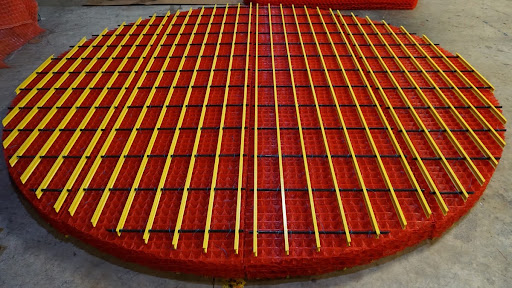
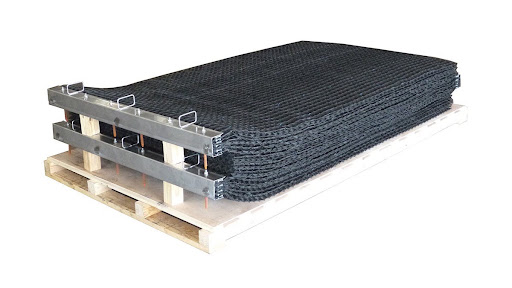
Kimre's B-GON® mesh pad mist eliminators apply this process using interlocking thermoplastic monofilament wires arranged perpendicular to the gas flow. Three physical mechanisms do the actual capturing:
- Impaction: a droplet's inertia carries it into a wire it cannot follow around.
- Interception: a droplet traveling close to a wire's surface is caught without needing to strike it directly.
- Centrifugal action: the curved path of gas around each wire flings suspended droplets outward into the media.
The construction gives B-GON® pads a void fraction of 94 to 97 percent, which keeps pressure drop low relative to denser conventional knitted mesh while still achieving high capture efficiency. Kimre manufactures the media in polypropylene, PVDF, ETFE, and PFA, with fiber diameters ranging from 0.05 mm to 0.94 mm, so the same basic mesh pad architecture can be tuned for different droplet loads, temperatures, and chemical environments.
Explore the full specifications of Kimre's B-GON® mesh pad mist eliminators.
Demister Pads for Two to Five Micron Droplet Removal
Demister pads are the mist eliminator most plants reach for first, because they cover the droplet range that shows up most often in scrubbing, distillation, and evaporation service. Kimre's B-GON® pads are effective for droplets from 2 to 5 microns, and even up to 10 microns and beyond, with capture efficiency exceeding 99 percent at 1 micron — outperforming conventional knitted mesh pads, which typically only capture droplets in the 3-to-5-micron range.
The separation itself relies on the same impaction, interception, and centrifugal mechanisms described above, but the pad geometry is specifically tuned for this mid-range droplet size.
Construction at a Glance
- Materials: polypropylene, PVDF, ETFE, and PFA, selected to match the process chemistry and temperature.
- Fiber diameter range: 0.05 mm to 0.94 mm.
- Void fraction: 94 to 97 percent, which keeps pressure drop low.
- Capture efficiency: 99-plus percent at 1 micron, extending to droplets of 10 microns and larger.
Because the pads are engineered and constructed from durable, corrosion-resistant thermoplastic materials rather than assembled from generic mesh, a properly specified and installed demister pad can remove nearly all of the mist load it is designed for, cutting solvent losses and fugitive emissions at the same time. That combination of coverage and durability is also why plant engineers evaluating a new scrubber or distillation column tend to size this technology first, then layer fiber bed or vane technology around it only where the droplet profile calls for it.
These pads also tend to be the lower-pressure-drop option relative to fiber bed filters or vane packs handling the same duty, which matters in applications where energy consumption or fan capacity is a constraint. Where the process runs cleaner and droplet loads stay in the 2-to-5-micron band, a well-specified mesh pad is usually the most cost-effective mist elimination choice available, and it remains cleanable and reusable across repeated service cycles rather than needing outright replacement after routine fouling.
Wear on a demister pad shows up gradually rather than all at once. Many plants track specific indicators, such as rising pressure drop, visible carryover, or falling capture at the fine end of the droplet range, to time a pad replacement or media repack before efficiency drops noticeably. These are the main warning signs that a demister pad needs replacement.
Check the full specifications of Kimre's mesh pad line before locking in your next demister pad order.
Fiber Bed Filters for Submicron Mist and Soluble Particulate
When droplets fall below one micron, mesh pads lose efficiency, and a different capture mechanism takes over.
Three Collection Mechanisms by Particle Size
- Impaction captures larger particles above 3 microns that cannot follow the gas stream around individual fibers.
- Interception catches particles above 1 micron that pass close to a fiber's surface.
- Brownian diffusion captures particles below 1 micron through their own random motion within the gas stream, which increases their odds of contacting a fiber.
Densely packed fine fibers arranged in cylindrical elements give fiber bed filters collection efficiencies of up to 99.9 percent, covering submicron droplets, soluble particulate, and insoluble solids in a single pass. That performance comes with a higher pressure drop than a mesh pad, typically in the range of 2 to 20 inches of water column, which is the trade-off for reaching into the submicron range.
Sizing and Installation Options
- Flow capacity: 10 CFM to 250,000 CFM.
- Single-filter units with integrated fans for smaller vent streams.
- Skid-mounted systems for mid-size installations.
- Field-assembled, custom-engineered systems for full-scale scrubber outlets.
That range makes fiber bed filters suitable for everything from a single vent stream to a full-scale scrubber outlet, and they see regular use in chemical, oil and gas, asphalt, pharmaceutical, and fertilizer processes, including phosphate fertilizer production, steel pickling, sulfuric acid manufacturing, and chlor-alkali operations.
Not sure what fiber bed filter size fits your submicron application? Talk to Kimre's engineering team for a recommendation built around your process.
Mass Transfer Equipment for Soluble Gas Absorption
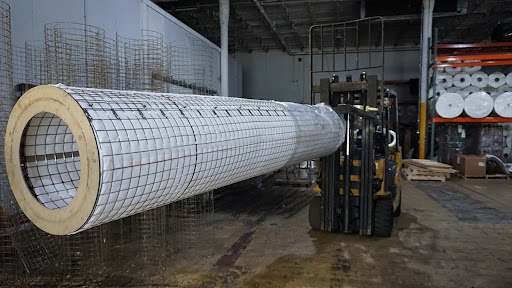
Mist elimination removes droplets that are already formed; mass transfer equipment goes a step further and pulls soluble gases out of the stream by bringing them into contact with a liquid. Kimre's KON-TANE® tower packing is built around this principle. It is a structured, interlaced monofilament material assembled into layered pads that can be stacked several feet deep while keeping their structural shape.
The packing's geometry is what makes the mass transfer work. Liquid cascades over the packing surface and breaks apart as it falls, so a droplet leaving one layer almost immediately contacts the next, continuously renewing the exposed liquid surface. That constant renewal is what drives efficient mass transfer, since the rate of gas absorption depends heavily on how much fresh liquid surface is available for contact at any given moment.
KON-TANE® Performance at a Glance
- A single 7-inch stage can deliver the equivalent of up to three mass transfer stages.
- It carries the highest liquid-to-gas ratio available among comparable products.
- It produces low pressure drop, prevents liquid holdup, and drastically reduces energy use.
Specifying a scrubber for your process? See what makes a packed tower scrubber design effective before you finalize the internals.
Wet Scrubbing and Tower Packing in Pollution Control
Wet scrubbing pairs mass transfer equipment with a liquid absorbent to remove soluble gases before they reach the stack, and KON-TANE® tower packing is designed specifically for this role inside crossflow and semi-crossflow wet packed tower scrubbers. Because the packing prevents liquid holdup while keeping pressure drop in the 50-to-150-mm water gauge range typical of medium-energy scrubbers, it reduces the fan and pump energy needed to move gas and liquid through the tower.
Maintenance Without Extended Shutdowns
The same structural design that drives mass transfer efficiency also simplifies upkeep. KON-TANE® packing can be assembled into removable cassettes, so operators can pull sections for:
- Pressure washing
- Solvent cleaning
- Physically working plugged material loose
All without shutting the scrubber down for an extended period. That matters in industrial air pollution control systems that cannot tolerate long outages, since packing that can be cleaned in place or swapped in modular sections keeps the scrubber closer to continuous operation.
This combination of gas absorption efficiency and low-downtime maintenance is why KON-TANE® packing shows up across chemical processing, petrochemical, and power generation scrubbers, and why Kimre pairs it with B-GON® mist eliminators in stage-wise systems such as the SXF™ semi-crossflow scrubber used in fertilizer applications. Not every internal in a scrubber does the same job, though: tower packing and chevron vane separators solve different problems, one built for gas absorption and the other for coarse droplet knockout, so choosing between them, or combining both, comes down to matching each internal to the specific duty it needs to perform.
Get a KON-TANE® tower packing recommendation for your scrubber.
Drift Elimination for Cooling Tower Carryover
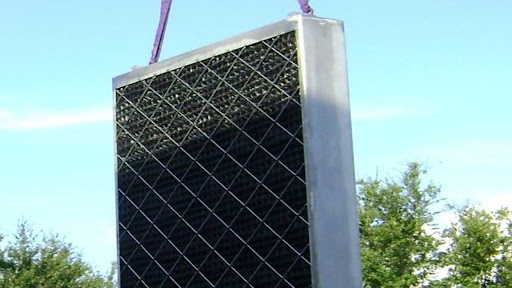
Drift is the water a cooling tower loses when liquid droplets get entrained in the exhaust air and carried out with it. Kimre's DRIFTOR® drift eliminator is an adaptation of the B-GON® mist eliminator, engineered to collect these droplets and drain the collected liquid away from the gas stream using Kimre's coarsest diameter monofilaments. It is made of polypropylene filled with carbon black for UV protection and an extended service life.
Where DRIFTOR® Is Installed
- Cross-flow cooling towers
- Counter-flow cooling towers
- Evaporative condensers
- Coolers
- Quench towers
Effective drift elimination prevents corrosion on surrounding piping, equipment, and electrical components, helps avoid icing of public roads, parking lots, and fields downwind of the tower, and reduces the emission of chemicals into the atmosphere. It improves system efficiency while cutting water loss and harmful emissions, and it protects nearby structures while reducing water treatment costs.
Protect your cooling tower from drift losses see Kimre's DRIFTOR® drift eliminators.
Liquid Coalescers for Downstream Phase Separation
Not every separation problem involves gas and liquid. Liquid-liquid separation, removing one liquid phase suspended in another, needs a different mechanism entirely, and it is the specialty of Kimre's LIQUI-NOMIX® coalescers. A unique filament structure creates a tortuous flow path that increases surface area and enhances droplet capture, and oleophilic polypropylene fibers cause fine droplets to merge into larger masses that rise and separate for removal, capturing droplets too small for conventional gravity separation to handle on its own.
The coalescer's multi-layered construction incorporates fiber diameters ranging from the largest to the finest in the industry, which lets a single cartridge handle a wider distribution of droplet sizes than a single-density media could. Water quality levels below 2 ppm can be achieved with ease, and the cartridges are custom-sized for easy installation both horizontally and vertically.
Typical Applications
- Final polishing step for OEMs handling oil-water separation
- Groundwater remediation
- Machining and steel processing wastewater
- Petrochemical and chemical process water
- Airport or parking lot runoff treatment
Because the polypropylene media resists fouling and can be cleaned and reused rather than discarded, LIQUI-NOMIX® systems hold up across all of these applications without frequent cartridge replacement.
See how a LIQUI-NOMIX® coalescer fits your specific flow rate and chemistry.
Matching Filtration Technology to Droplet Size and Gas Load
With several mist elimination technologies covering overlapping ranges, the practical question is which one fits a specific droplet size and gas load. The table below compares Kimre's B-GON® mesh pad mist eliminators against vane-type separators across the factors that matter most for that decision.
| Factor | Mesh Pad Mist Eliminators | Vane-Type Separators |
| Typical droplet range | Fine, down to about 1 micron and below | Coarse, generally above 20 microns |
| Pressure drop | Low, aided by high void fraction (94-97%) | Very low, especially at high flow rates |
| Fouling behavior | Can foul in dirty streams; cleanable and reusable | More fouling-resistant due to open channel design |
| Best-fit gas load | Medium to high velocity | High velocity with heavy mist loads |
| Typical applications | Sulfuric acid towers, chemical scrubbers, chlor-alkali plants, absorption towers | Cooling towers, evaporators, brine and salt drying, desalination |
Getting this match right is not just an efficiency question. A mesh pad handling a gas load it was not sized for will foul faster and lose collection efficiency, while a vane separator asked to capture submicron mist will let fine droplets pass straight through.
A Quick Decision Framework
- If the stream is fine and submicron, start with a fiber bed filter.
- If it sits in the common 2-to-5-micron mid-range typical of scrubbers and evaporators, start with a mesh pad.
- If the stream runs at high velocity with coarse, heavy mist loads and lower fouling risk, a vane-type separator is usually the better fit.
Many real installations end up combining two of these technologies in sequence rather than relying on one alone, particularly where the contaminant load varies across a plant's operating range.
See the full mesh pad vs. vane separator comparison before you specify your next mist eliminator.
Material Selection for Corrosive and High Temperature Service
Choosing the right mist eliminator or scrubber internal only solves half the problem; the material it is built from has to survive the process of chemistry and temperature over years of continuous service.
Material Options by Service Condition
- Stainless steel (304 or 316 grade and higher alloys): holds up well in high-temperature or oxidizing environments; sees regular use in sulfuric acid production and metal refining.
- Fiberglass-reinforced plastic (FRP): combines strong corrosion resistance at moderate temperatures with a lighter weight than metal; favored in fertilizer and phosphoric acid production.
- Thermoplastics (PVC, CPVC, polypropylene, and, in Kimre's own media, PVDF, ETFE, and PFA): cost-effective and corrosion-resistant for lower-temperature applications handling mildly corrosive vapors or condensable organics.
- Specialty alloys (Hastelloy, titanium): reserved for halogenated compounds or hot acid vapors that would attack more common materials.
Selection Criteria Beyond Corrosion Resistance
- Thermal expansion
- Erosion risk
- Susceptibility to solvent stress cracking
- Ease of fabrication into the needed shape
- Overall weight
- Accessibility for maintenance
Getting any one of these factors wrong can shorten service life even if the material resists the chemical attack it was chosen for.
Get the material choice right the first time check Kimre's full breakdown of wet scrubber material choices.
Designing Industrial Air Pollution Control Systems in Stages
Some emissions problems cannot be solved with a single piece of equipment, and staged design becomes necessary once contaminants span a wide size range within one gas stream. Kimre's AEROSEP® system is a clear example, built to capture aerosol particles as small as 0.2 micrometers using a four-stage, nucleated-condensation approach rather than a single filtration pass.
AEROSEP®'s Four Stages
- Stage 1, pre-conditioning: removes particles 3 microns and larger.
- Stage 2, particle growth: the remaining fine particles grow to roughly 1 micron through nucleated condensation.
- Stage 3, coalescing: the grown particles coalesce inside a B-GON® mist eliminator until they reach 10 to 12 microns.
- Stage 4, final entrainment separation: removes the now-enlarged droplets.
Because AEROSEP® uses a modular vessel design with interchangeable KON-TANE® and B-GON® components, it can be installed faster than a comparable custom-built system and maintained by pulling individual modules rather than shutting down the entire train.
This staged approach also shows up in industrial air pollution control systems built for phosphate fertilizer plants, where reaction, filtration, evaporation, granulation, and drying each generate a different contaminant load and often need their own combination of dust collection, mist elimination, and gas absorption equipment working together rather than a single unit trying to handle every stage of the process at once.
Request an AEROSEP® system recommendation for your submicron aerosol control needs.
Partnering With Kimre for Custom Engineered Solutions
Because Kimre™ Clean Air Technology both designs and manufactures its own mist elimination, tower packing, and coalescer media, project teams work directly with the same organization that built the equipment rather than routing engineering questions through a separate distributor. That single point of accountability tends to matter most during a retrofit, when the existing vessel geometry, ductwork, and process conditions rarely match a catalog assumption exactly, and the equipment has to be engineered around the constraints already in place rather than the other way around.
Selecting industrial air filtration systems for a process plant comes down to matching equipment to the contaminant actually present: droplet size, gas velocity, chemistry, and temperature all narrow the choice before cost or footprint ever enter the conversation. Whether the need is a mesh pad for mid-range mist, tower packing for gas absorption, a drift eliminator for a cooling tower, or a fully staged system for a complex contaminant mix, the underlying principle stays the same: build the system around the process, not the other way around.
Ready to specify a system built around your process? Contact Kimre to get started.
Frequently Asked Questions
What is the difference between a demister pad and a mist eliminator?
It is a type of mist eliminator built from knitted or interlocking mesh, typically effective on droplets in the 2-to-5-micron range and larger. The broader category of mist eliminators also includes fiber bed filters and vane-type separators, which extend capture down to submicron droplets or up to higher gas velocities than a standard mesh pad handles.
How do I know which mist elimination technology fits my process?
The right choice depends primarily on the droplet size distribution and gas velocity in the actual stream, along with the chemical and temperature environment. Fine, submicron mist generally calls for fiber bed filtration, mid-range droplets in the 2-to-5-micron band suit a mesh pad mist eliminator, and coarse, high-velocity streams often fit a vane-type separator better than either.
Can tower packing and mist eliminators be used together?
Yes. Many scrubbing systems combine mass transfer equipment such as KON-TANE® tower packing, which absorbs soluble gases, with a mist eliminator such as a B-GON® pad, which then captures any liquid droplets generated by the scrubbing process itself before the gas exits the stack.
What materials hold up best in corrosive gas streams?
It depends on the specific chemistry and temperature. Stainless steel and higher alloys suit high-temperature, oxidizing conditions; fiberglass-reinforced plastic performs well in moderate-temperature chemical scrubbing; thermoplastics such as polypropylene and PVDF are cost-effective for mildly corrosive, lower-temperature service; and specialty alloys like Hastelloy or titanium are reserved for the most chemically aggressive environments.
Why would a plant need a staged air pollution control system instead of one unit?
Staged systems become necessary when a single gas stream carries contaminants across a wide size range or of different types, such as coarse particulate alongside submicron aerosols. Systems like Kimre's AEROSEP® handle this by processing the stream through sequential stages, each targeting a different particle size, rather than asking one unit to capture everything in a single pass.
Can existing mist elimination or scrubbing equipment be retrofitted rather than replaced?
Often, yes. Because technologies such as KON-TANE® tower packing and B-GON® mist eliminators are built around modular, cassette-style media, they can frequently be retrofitted into an existing vessel or scrubber shell rather than requiring a full equipment replacement, which is part of why Kimre positions custom engineering as central to a retrofit project rather than treating it as a simple parts swap.

