
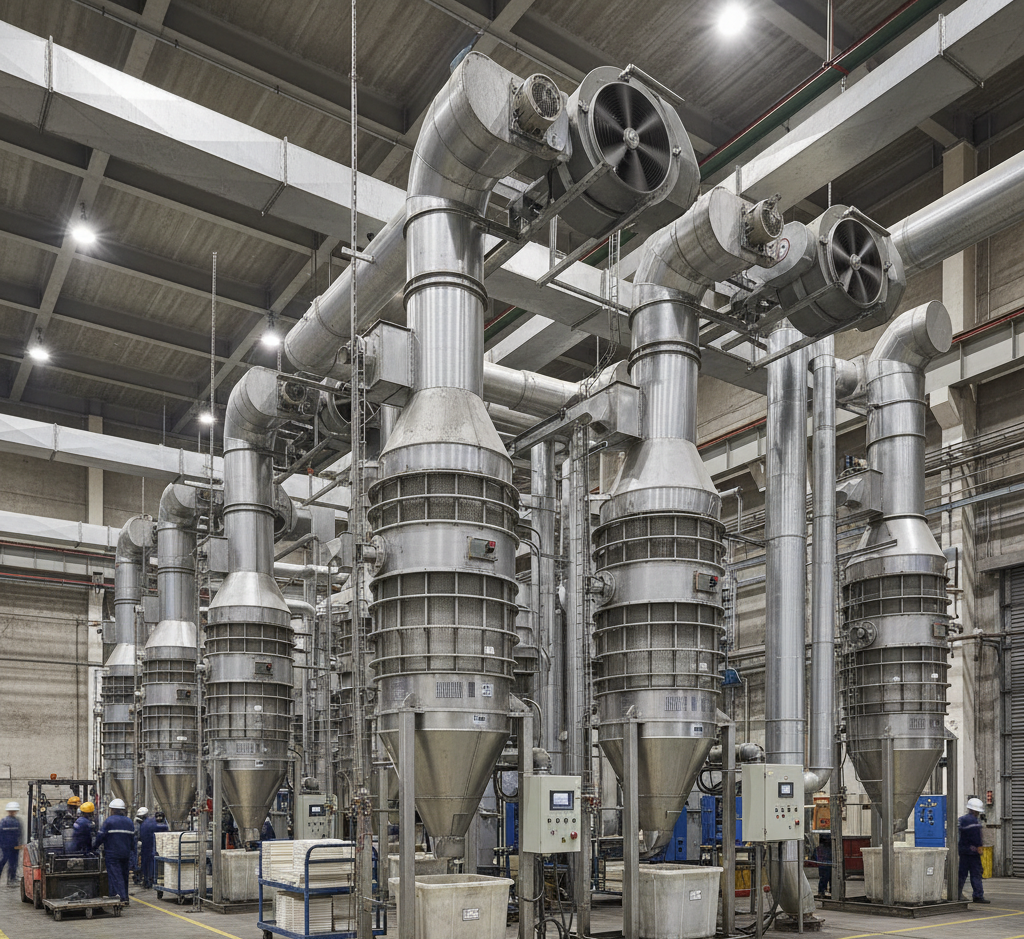
Power generation facilities operate under thermodynamic and chemical conditions where marginal inefficiencies in emission control propagate into measurable environmental and mechanical consequences. Combustion of fossil fuels produces particulate matter, sulfur oxides, nitrogen oxides, and acid aerosols, each requiring targeted separation or conversion mechanisms to ensure compliance and preserve system integrity. The question is not whether control is necessary, but rather: What emission control products are available for power generation industries?
From an engineering standpoint, modern plants employ coordinated, multi-stage gas treatment architectures. These systems are designed to maintain removal efficiency across variable load profiles while minimizing pressure drop, reagent consumption, and maintenance burden. Performance is evaluated not only in terms of outlet concentration, but also by long-term operational stability.
Air pollution control remains a non-negotiable requirement due to the scale and chemical diversity of flue gas streams. Uncontrolled emissions accelerate environmental degradation, introduce public health liabilities, and compromise plant assets through corrosion, fouling, and thermal imbalance. Properly specified systems mitigate these risks while aligning operations with regulatory thresholds that continue to tighten across jurisdictions.
A practical response to the question, What emission control products are available for power generation industries?, requires examination of the principal unit operations:
Electrostatic precipitation provides high-efficiency particulate capture by imposing an electrical field that induces particle migration toward collection plates. This method is particularly effective for fine ash fractions under stable gas conditions.
Fabric filtration systems, commonly referred to as baghouses, employ engineered media to achieve near-total particulate removal. Their performance is less sensitive to particle resistivity but requires careful thermal and chemical management of the gas stream.
Flue gas desulfurization units apply mass transfer and chemical reaction principles to remove sulfur dioxide, typically through wet scrubbing with alkaline sorbents. Reaction kinetics, liquid distribution, and scaling control are central to sustained efficiency.
Selective catalytic reduction systems address nitrogen oxides through catalytic conversion, introducing a reductant such as ammonia to produce nitrogen and water. Catalyst activity, residence time, and temperature control define system effectiveness.
Mist elimination technologies function as the final polishing stage, removing entrained droplets and acid mist that persist after upstream treatment. These systems rely on controlled coalescence, inertial impaction, and surface engineering to achieve submicron separation without excessive pressure loss.
In practice, these technologies are not deployed in isolation. Upstream particulate removal reduces loading on downstream chemical systems, while final-stage mist elimination ensures discharge quality meets stringent opacity and aerosol standards. Integration is dictated by fluid dynamics, reaction engineering, and plant-specific constraints.
Selection of appropriate systems is governed by fuel composition, flue gas volume and temperature, emission limits, spatial constraints, and lifecycle cost considerations. Each installation represents a tailored solution rather than a generic configuration. Thus, revisiting the central question, What emission control products are available for power generation industries? one finds that the answer lies in engineered combinations, not individual devices.
Beyond compliance, well-designed emission control systems provide measurable operational advantages. Reduction of corrosive species extends equipment life, stabilized gas composition improves downstream reliability, and minimized fouling reduces maintenance frequency. These are not secondary benefits; they are integral to maintaining continuous, efficient plant operation.
Kimre Clean Air Technology approaches this domain with a focus on high-efficiency filtration and phase separation technologies engineered for demanding flue gas environments. Their systems are designed to integrate with existing plant infrastructure while delivering consistent removal performance under variable operating conditions. For facilities evaluating upgrades or new installations, engagement with Kimre provides a pathway to implement durable, performance-driven emission control solutions aligned with modern power generation requirements.

