
A mist eliminator solves a problem that sounds simple on the surface. Separating tiny liquid droplets from a moving gas stream before the gas leaves a vessel, stack, or scrubber comes down to three numbers: droplet size, gas velocity, and liquid loading. Nail those three and almost any mist eliminator design becomes a matter of matching known physics to known conditions. Miss them, and no brand name or equipment category saves the installation from re-entrainment, fouling, or an emissions exceedance.
Most explanations of demisting jump straight to product categories, mesh pads, vanes, fiber beds, as if choosing between them were a matter of taste. It isn't. Media selection follows directly from droplet size distribution, the velocity of the gas moving through your vessel, and how much liquid the unit has to shed without flooding or throwing it back into the gas stream. Everything else in this guide, like construction, materials, pressure drop, and fouling resistance, traces back to those three numbers. That holds true whether you're selecting a simple polishing pad or a heavy-duty industrial mist eliminator for a corrosive absorption tower.
What A Mist Eliminator Does
A mist eliminator removes entrained liquid droplets from a gas stream by forcing the gas through a bed of media, where droplets collide, coalesce, and drain away by gravity, leaving drier, cleaner gas behind.
You can set it up inside or at the outlet of various process vessels, like scrubbers, absorbers, distillation columns, evaporators, or even storage tank vents. Its job is to catch pesky liquid droplets mixed into a gas stream before the gas exits. The best part? It doesn’t rely on any chemicals or moving parts.
As the gas flows through a bed of media, fibers, mesh, or vanes, the droplets bump into the media, merge into larger droplets, and then simply drain back down by gravity into the process liquid below. This means the vessel produces a much drier, cleaner gas. It also helps retain liquid your process would otherwise lose, along with any corrosive or polluting substances that might have been riding along.
Whether the team on site calls it a mist eliminator filter or simply a demister, the working principle stays the same: catch the droplet, coalesce it, drain it away.
Not every mist eliminator manufacturer builds to the same standard, which is exactly why droplet size, velocity, and liquid loading matter more than brand name alone.
Why Entrained Liquid Costs More Than It Appears To
Entrained mist rarely announces itself the way a leak or a spill does. It leaves quietly, riding the gas stream as a fine aerosol, and the cost shows up somewhere else in the plant weeks or months later. This delay explains why mist carryover gets underinvested relative to the damage it causes.
Emissions And Compliance Exposure
Uncaptured mist carries acid gases, particulates, and volatile compounds straight out the stack. Limits on opacity, particulate matter, and pollutants like sulfuric acid mist or hydrogen fluoride get written around this exact failure mode.
Stack testing finds an undersized or fouled demister before an inspector does. Reliable mist elimination keeps you permit-compliant instead of triggering corrective action.
Downstream Corrosion And Fouling
Acidic or caustic droplets that escape separation land on downstream ductwork, fans, heat exchangers, and instrumentation.
Chronic exposure accelerates corrosion in equipment never designed for liquid contact, and deposits scale, degrading heat transfer and airflow over time.
Product And Reagent Loss
In absorption towers and evaporators, entrained liquid often is the product itself, phosphoric acid, ammonium salts, or process reagents. Every uncaptured droplet is lost yield.
Plants running tight margins on reagent consumption or product recovery have a direct financial reason to treat mist elimination as an economics question, not only an environmental one.
Capacity Limits And Unplanned Downtime
An undersized or fouled mist eliminator eventually becomes the bottleneck for the whole vessel. Operators throttle gas flow to limit carryover, and production rate caps out. Left unaddressed, fouling and flooding force an unplanned shutdown for cleaning or replacement, usually at the worst point in a production schedule.
How Droplets Are Captured
These four mechanisms explain why mist eliminator manufacturers make such different design choices depending on the droplet size their equipment targets.
Inertial Impaction
Larger droplets, typically those over 3 to 5 microns, have enough momentum to resist the gas stream's curves around a fiber or vane. Their inertia drives them straight into the collection surface, where they get trapped.
This mechanism is particularly effective in vane separators and coarser mesh pads, and it becomes even more efficient as velocity increases until it reaches a point where the speed is so high that it can pull droplets back off the media.
Direct Interception
Mid-sized droplets, roughly 1 to 3 microns, follow gas streamlines closely. Close enough, in fact, for a streamline passing near a fiber to bring the droplet's own radius into contact with it anyway.
Interception depends heavily on fiber diameter. Finer fibers intercept better because streamlines pack tighter around them.
Brownian Diffusion
Sub-micron droplets are small enough for random collisions with gas molecules to knock them off their streamline. This erratic motion increases the odds a droplet wanders into a fiber and sticks, even though its size would let it slip past every other mechanism.
Diffusion explains why fiber bed filters reach efficiencies up to 99.9 percent on droplets under a micron. On the flip side, diffusion capture improves at lower velocity, the opposite of impaction.
Coalescence And Drainage
Capturing droplets is just part of the process. Once captured, droplets must merge with their neighbors, grow large enough for gravity to take over, and drain out without being pulled back into the gas stream. If the media captures droplets effectively but drains poorly, it can become saturated. This increases pressure drop and can eventually push liquid back into the gas stream, reversing the separation that just occurred.
Droplet Size Distribution As The Governing Variable
Industrial mist never comes in a single droplet size. It comes as a distribution, typically skewed toward finer droplets, and this distribution determines how hard the separation problem is. A scrubber generating mostly 10 to 50 micron droplets from spray nozzles presents a fundamentally different challenge than an absorption tower generating sub-micron acid aerosol from a chemical reaction. Impaction-based media solve the first. Diffusion-based fiber beds handle the second.
So, "What mist eliminator do I need?" sets up the wrong question. The right one: what does your droplet size distribution look like, and what's the smallest droplet you need to control to hit your emissions or recovery target? Media type, fiber diameter, void fraction, and pressure drop budget all follow from answering it accurately.
Mist Eliminator Types And Where Each Fits
Structured Mesh Pad Media
Structured mesh pads are the industry workhorse: cost-effective, broadly applicable, and capable of handling droplet sizes from roughly 3 microns up. When fibers sit oriented in a defined pattern instead of randomly knitted, they generally outperform traditional random-knit mesh on both efficiency and pressure drop. More fiber surface sits perpendicular to gas flow, where it does the actual collection work.
Kimre's B-GON® pads use this structured, ladder-like fiber arrangement to push efficiency above 99% for droplets down to 1 micron, without the pressure-drop penalty typical of older mesh designs.
Fiber Bed Candle Filters
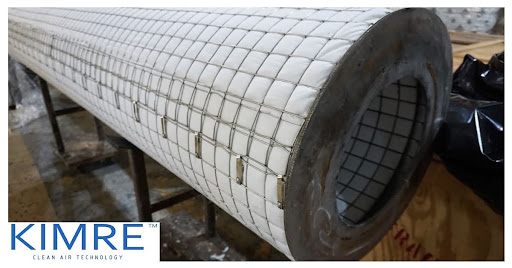
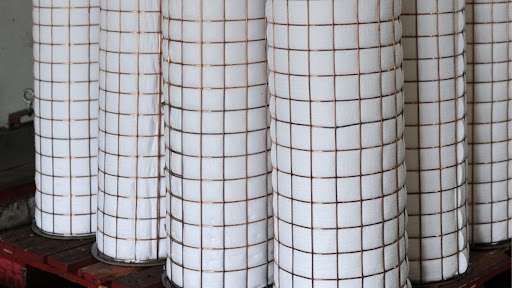
When droplets are sub-micron and the application is emission-sensitive, fiber bed candle filters take over. These cylindrical elements pack dense fiber media into a compact footprint and rely mainly on Brownian diffusion, reaching efficiencies up to 99.9 percent on the finest aerosols. Sulfuric acid plants and chemical process vents rely on this technology wherever limits target sub-micron particulates. Kimre builds fiber bed candle filters as new elements or re-packs, fitting new high-performance media into your existing filter cages to cut both cost and downtime. As a mist eliminator filter built around dense fiber packing rather than open mesh, the candle format reaches droplet sizes other media types simply miss. The media works as a coalescing bed. Learn how candle filters capture fine mist mechanics in detail.
The two technologies overlap around the 1-micron mark, which is where most selection mistakes happen. Our comparison of mesh pads vs fiber bed candle filters shows which one fits once pressure drop, liquid loading and vessel space are factored in.
Knitted Wire Mesh
Traditional randomly knitted wire or fiber mesh remains common because it costs less and engineers understand it well. It captures droplets down to roughly 3 to 5 microns, but has real limitations. Liquid-handling capacity trails, structured alternatives, and random fiber orientation makes it prone to fouling from insoluble solids, with no defined path for trapped particulates to work loose.
Vane And Chevron Separators
Vane, or chevron, separators are plate-type units built for high liquid loads and larger droplets rather than fine mist. Gas gets forced through a zig-zag path between angled plates, and momentum carries coarser droplets into the plate surfaces. Chevrons handle much higher liquid volumes than mesh pads without flooding. Efficiency drops sharply below roughly 20 microns, which is why plants often pair chevrons with a finer secondary stage instead of using them alone.
Structured Media Construction And Why Fiber Orientation Matters
The key difference between high-performance structured media and regular knitted mesh lies in how the fibers are oriented. In a knitted pad, fibers loop around randomly, so only a small portion of the fiber surface faces the gas flow at any given time. The remaining fibers run parallel, which doesn’t improve collection efficiency and still contributes to pressure drop.
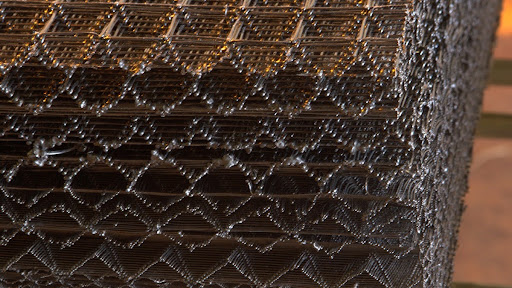
In contrast, structured interlocking media made from thermoplastic monofilament fibers are designed in a three-dimensional, ladder-like pattern. This clever arrangement ensures that nearly all of the fiber surface is oriented perpendicular to the gas flow. This design significantly boosts the effective collection area that droplets can interact with, all without the added pressure drop that comes from cramming more random fibers into the same space. Fiber orientation is only one part of what separates a high-performing pad from an average one. The other key features of a demister pad cover drainage, void space and cleanability.
Fiber Diameter And Void Fraction As Design Variables
Finer fibers improve interception and diffusion capture. Tighter streamline curvature pulls more droplets into contact.
But finer fibers, without enough open void space, pack the bed too densely, driving pressure drop up and fouling it quickly with insoluble solids. High-performance structured media typically come in a wide range of fiber diameters, roughly 0.05 mm to nearly 1 mm, with void fractions around 94 to 97 percent. This keeps the bed open enough to resist fouling and drain freely while still capturing small droplets. Matching fiber diameter and void fraction to your actual droplet size and contaminant loading marks where mist eliminator design stops being generic and starts being engineering.
Composite Media For Wide Droplet Distributions
Real process streams rarely present one uniform droplet size. They span coarse spray carryover down to sub-micron condensation aerosol, often in the same vessel, and a single media layer optimized for one end underperforms on the other.
Composite pads solve this by layering different mesh styles, fiber diameters, or void fractions in one unit. A coarser, high-capacity layer sits upstream for bulk liquid and larger droplets, followed by a finer layer tuned for the smaller droplets surviving the first pass. This lets a single mist eliminator maintain efficiency across a wider droplet range without a pressure-drop penalty across the whole bed.
Gas Velocity, Load Point And The Operating Envelope
Every mist eliminator operates inside a window bounded on both ends by velocity. Below the minimum design velocity, capture efficiency on fine droplets drops because there isn't enough momentum to drive impaction, and gas simply carries droplets around the fiber surfaces.
Above the maximum, gas moving through the media starts stripping liquid back off the fibers faster than the bed drains it away. Re-entrainment often pushes carryover higher than it would be without a mist eliminator.
The load point marks the velocity where liquid starts accumulating faster than it drains, setting the upper limit of stable operation. Sizing correctly means keeping design velocity comfortably inside this window across the full range of flow your vessel will see, not only nameplate capacity.
Pressure Drop And Its Real Cost In Fan Energy
Pressure drop across a mist eliminator amounts to more than a datasheet spec. It represents ongoing fan or blower energy cost for the life of the installation.
Here's the tradeoff worth sitting with: a media choice that saves a few points of efficiency but adds several inches of water column often costs more in electricity over a decade than it saves in upfront capital. Structured, perpendicular-fiber media generally holds an advantage, matching or beating random-knit mesh on efficiency at lower flow resistance. Fiber bed filters inherently run higher, typically 2 to 20 inches of water column, because sub-micron diffusion capture needs a denser bed than coarser impaction media. Worth the cost when sub-micron control is genuinely required. Not worth it when it isn't.
Re-Entrainment And The Role Of Drainage Design
Re-entrainment is the quiet failure mode that can undo an otherwise well-selected mist eliminator. Captured liquid can't drain out fast enough and gets picked back up by the gas stream, sometimes as droplets larger than what the unit was designed to remove in the first place.
Good drainage design addresses this directly. Media oriented for a clear gravity path out of the gas flow. Adequate spacing before any downstream ductwork transition. Where loading runs high, a sump or collection tray sized for the actual volume drains off. Re-entrainment almost always comes down to drainage geometry, not media efficiency, which is why finer media alone rarely fixes it.
Liquid Loading And Hydraulic Capacity
Liquid loading, the volume of liquid your mist eliminator has to shed per unit of time, forms a separate design constraint from droplet size, and engineers often underestimate it. A unit with excellent capture efficiency on paper still fails in service if liquid volume exceeds its hydraulic capacity and the bed floods before draining.
High-void-fraction media handles this better than dense, low-void media, simply because more open channels let liquid drain through without blocking gas flow. Applications with heavy carryover, spray scrubbers, and high-recirculation towers often need a coarser, higher-capacity stage ahead of the fine-collection stage, or a vane-type pre-separator to knock down bulk liquid first.
Turndown And Variable Process Conditions
Few industrial processes run at one constant flow rate. Batch operations, seasonal demand, and startup and shutdown cycles mean the mist eliminator must maintain acceptable efficiency across a range of velocities, not only at the design point.
Turndown, the amount the flow drops before efficiency collapses, varies by technology. Diffusion-dominated fiber bed media gains an advantage at low flow since diffusion improves as velocity drops. Impaction-dominated media struggles at low velocity for the opposite reason. Understanding the real operating range your vessel will see, rather than its nameplate rating alone, ranks among the more commonly skipped steps in sizing, and a common cause of underperformance once a unit goes in.
Materials Of Construction For Corrosive And Hot Service
Mist eliminator media must survive the same corrosive, hot environment as the process itself, so material selection is a genuine engineering decision, not an afterthought. Thermoplastic media is available in materials chosen to match specific temperature and chemical exposure.
| Material | Common Abbreviation | Typical Temperature Resistance |
| Polypropylene | PP | up to about 210°F |
| High Temperature Polypropylene | HTPP | up to about 230°F |
| Polyethylene Terephthalate | PET | up to about 210°F |
| Polyvinylidene Difluoride | PVDF | up to about 235°F |
| Ethylene Tetrafluoroethylene | ETFE | up to about 300°F |
| Perfluoroalkoxy Alkane | PFA | up to about 400°F |
The wrong resin fails years early in acid service, which is why material choice drives mist eliminator service life. Sulfuric acid, hydrochloric acid fume, and chlorine service generally push toward PVDF, ETFE, or PFA for chemical resistance, with fluoropolymers like PFA extending into higher-temperature duty. Wrong material selection shortens service life. In acid service, it can cause media failure well before the design interval, releasing the very contaminants the unit exists to capture.
Not all mist eliminator manufacturers offer this full range, which is exactly why material selection can force a compromise on efficiency or service life if you're locked into one supplier's standard lineup.
Fouling Resistance And Wash System Design
Fouling, the gradual buildup of insoluble solids, scale, or polymerized deposits inside the media, ranks as the most common reason a well-selected mist eliminator underperforms over time. High void fraction and larger fiber diameter resist fouling better than dense, fine media, since more open pathways let solids pass through instead of bridging and blocking. Not every deposit behaves the same way. Salts, gypsum scale, sticky organics and poor wash coverage each foul media differently, as our breakdown of the common causes of mist eliminator fouling explains.
For heavier particulate loading, an integral wash system, nozzles periodically rinsing the media face and flushing solids to drain, extends service intervals, and engineers usually design it in from the start. Media genuinely cleanable and reusable matters too. It turns fouling into a maintenance decision instead of a replacement one.
Kimre designs wash systems directly into B-GON® installations from the start, giving fouling-prone applications a built-in path to longer service life instead of an afterthought bolted on later.
Multi-Stage Separation Systems
Single-stage mist elimination often falls short when a process generates a wide droplet distribution, high liquid loading, and a strict sub-micron target all at once. Multi-stage aerosol separation systems combine complementary technologies in sequence: a coarse pre-separator or packed bed to knock down bulk liquid and larger droplets, then a fine mist eliminator stage tuned for the sub-micron carryover surviving the first pass.
Staging lets each stage do the job it does best. It usually results in a lower overall pressure drop than forcing one ultra-fine stage to handle everything alone.
Mist Eliminators Within Scrubbers, Absorbers And Towers
A mist eliminator rarely works alone. It typically sits as the final stage of a scrubber, absorption tower, or evaporator, positioned wherever gas exits after contacting process liquid.
In semi-crossflow scrubber designs, structured packing handles gas absorption and scrubbing in one section. At the same time, a downstream mist eliminator stage captures the droplets the scrubbing process generates, since contacting gas with liquid to absorb a contaminant inevitably creates some mist as a byproduct. Packing and vanes do different jobs inside the same vessel, as our comparison of tower packing vs chevron vanes in scrubbers explains. Positioning matters here. The unit needs reasonably uniform gas velocity across its face, since a poorly distributed flow profile drives local velocity spikes that cause re-entrainment even when the vessel-wide average looks fine on paper.
Retrofitting An Existing Vessel
Not every mist elimination upgrade starts with a new vessel. Retrofits, replacing failed or undersized media inside an existing tower, scrubber, or filter housing, happen often, particularly when a plant chases tighter emissions limits than the vessel's original design allowed.
A well-executed retrofit works within the existing footprint and support structure. The replacement media requires custom fabrication to the original dimensions, orientation, and nozzle configuration exactly, since older vessels frequently deviate from their original drawings. Retrofits often cost less than a full vessel replacement, and modern structured media dropped into an older knitted-mesh installation often delivers meaningful efficiency and pressure-drop improvements without touching the surrounding equipment.
Installation, Support, and Sealing
Even excellent media underperforms when installed poorly. Gas finds the path of least resistance.
A unit with gaps around its edges, a bed sagging under liquid load, or a poor seal against the vessel wall lets gas bypass the media entirely, carrying its mist right with it. Support grids must hold the media rigid under the combined weight of the bed plus accumulated liquid. Edge seals need fabrication to the vessel's actual as-built dimensions rather than nominal drawing dimensions, since older vessels often deviate from spec. This ranks among the more overlooked parts of any installation, and one of the cheapest problems to prevent if caught during fabrication rather than after startup.
Inspection, Cleaning And Replacement
Mist eliminators stay largely passive once installed, but they aren't maintenance-free. Periodic inspection, checking for damage, localized fouling, sagging, or signs of re-entrainment downstream, catches problems while they're still cheap to fix. Candle filters fail in different ways, and most failures are preventable. Here are the maintenance issues that cause unplanned downtime.
Cleaning intervals depend on your process's fouling tendency. Genuinely cleanable, reusable media allows in-place washing instead of replacement, lowering lifecycle cost. When replacement becomes necessary, reassess whether the original media selection still matches current conditions, since throughput and process chemistry drift over years of operation.
Standard Products Against Custom Engineered Solutions
Standard catalog mist eliminator pads and filter elements in common sizes and materials serve some applications perfectly well, and there's no reason to over-engineer a straightforward, well-understood duty.
But plenty of installations don't fit standard dimensions, droplet distributions, or chemical exposure, and custom engineering earns its keep there. A custom-designed mist eliminator accounts for your vessel's actual dimensions, the real droplet distribution and liquid loading, allowable pressure drop, and the exact temperature and chemical exposure the media will face. Engineers then build fiber diameter, void fraction, and material of construction around those specifics instead of forcing the application to fit an off-the-shelf product. The deciding factors are usually chemistry, droplet range, vessel geometry, liquid loading or a tighter emissions limit. Our guide to custom versus standard mist eliminators walks through each trigger and what the engineering process involves. For OEMs and plants running non-standard vessels or unusual process chemistry, this difference shows up directly in service life and performance.
Applications Across Process Industries
Phosphate And Nitrogenous Fertilizers
Phosphate and nitrogenous fertilizer production generates off-gas loaded with fluorides, ammonia, ammonium phosphates, and dust at multiple steps: reaction, filtration, evaporation, granulation, and drying. Mist eliminators paired with scrubbing packing capture this load in stages, recovering product back into the process while meeting fluoride and particulate limits ranking among the tightest in the chemical industry.
Sulfuric Acid And Chlor-Alkali
Sulfuric acid absorption towers, sulfur-burning, regeneration, or metallurgical off-gas generate acid mist ranging from sub-micron aerosol up to larger droplets. Engineers match diffusion-based and impaction-based fiber bed filters, often in composite designs, to each plant type's efficiency and pressure drop targets. Chlor-alkali gas cleaning faces a similar challenge with corrosive, contaminant-laden streams where material selection matters as much as media design.
Steel Pickling And Metal Finishing
Steel and stainless pickling lines use hydrochloric or sulfuric acid to strip scale and oxide, generating acid fume and mist whose droplet size depends heavily on the motive air system. Higher-energy spray and air draw-off systems generate finer, harder-to-capture mist. HCl fume scrubbers built around structured mist eliminators and tower packing stand as the established solution for both continuous and batch pickling, and plants often specify them to meet Best Available Technology standards on retrofits.
Asphalt, Oil Mist And Plasticizers
Hot asphalt application, in roofing manufacturing and storage tank venting alike, vaporizes lighter fractions condensing into a visible blue haze in exhaust air. Fiber bed filters and mist eliminators serve as both primary control technology and pre-filters ahead of thermal oxidizers, protecting downstream systems by removing condensable material first. Oil mist and plasticizer vents follow the same logic. Catch the condensable aerosol before it escapes as emissions or fouls downstream equipment.
What Data To Provide For A Sizing Recommendation
A meaningful sizing recommendation depends entirely on the process data. At minimum, an engineer evaluating your application needs:
- Gas flow rate and expected range: minimum, normal, maximum
- Gas composition, temperature, and pressure at the mist eliminator location
- Droplet size distribution, or your best available estimate
- Liquid loading, entrained liquid volume per unit of gas volume
- Chemical composition of the entrained liquid and any corrosive constituents
- Vessel dimensions and orientation
- The installation space you have available
- Target removal efficiency and applicable emissions or recovery limits
- Your allowable pressure drop budget
The more you supply upfront, the less iteration it takes to land on a design that performs at startup instead of needing rework afterward.
Why Process Engineers Work With Kimre
Kimre has spent more than fifty years designing and manufacturing mist elimination equipment. It started in 1973, when founder George C. Pedersen, an MIT-trained chemical engineer, built the company around one goal: cleaner air, water, and gas-liquid process operations.
This history now spans more than 40,000 installations across every continent, and the lineup reflects that breadth. B-GON® structured mesh pad mist eliminators and Fiber Bed Candle Filters can capture sub-micron particles with 99.9% efficiency. KON-TANE® tower packing. LIQUI-NOMIX® liquid coalescers. DRIFTOR® drift eliminators for cooling towers. Complete AEROSEP® multi-stage separation systems.
For an engineer specifying equipment, this breadth means choice without compromise. One manufacturer supplies the right technology for your droplet size and process condition, instead of stretching one product to cover everything. Product range is only one test. See how to judge a mist eliminator supplier before you specify. Kimre's engineering team reviews flow rate, droplet distribution, liquid loading, and chemical exposure before recommending a standard product or a custom-engineered one, including fabricating structured media to fit existing vessels for retrofits and fiber bed re-pack services reusing existing filter cages with new high-performance media. If you're evaluating a mist elimination system, new or underperforming, Kimre's team helps translate your process data into a design holding up in service.
Specifying A Mist Eliminator That Performs Long Term
Mist elimination might not be the most glamorous part of industrial processes, but it plays a crucial role. It’s the final checkpoint before gas exits the system, offering the last chance to capture liquid, product, or contaminants before they become someone else's headache downstream.
The science behind it is pretty straightforward. Concepts like impaction, interception, diffusion, and coalescence cover nearly all the bases in how a specific medium performs. Factors such as droplet size, velocity, and liquid loading are key in determining which medium to choose. By treating mist elimination as a calculation rather than just a category selection, you can distinguish between installations that will thrive for a decade and those that will require rework within a year.
Whether you’re designing a new system or fixing one that’s not performing well, always start with the process data. Kimre's engineering team works through this exact data with plants every day, on new installations and on equipment already in service, turning process numbers into a design holding up long term.
Frequently Asked Questions
What does an industrial mist eliminator remove?+
It removes entrained liquid droplets and aerosols, acid mist, condensable oils, process liquid carryover, and fine particulate suspended in the liquid from a gas stream before it exits a vessel or stack.
What is a mist eliminator pad made of?+
Manufacturers make most mist eliminator pads from thermoplastic monofilament fibers such as polypropylene, PVDF, ETFE, or PFA, knitted or structured into mesh and chosen for temperature and chemical resistance.
How long does a mist eliminator last in service?+
Service life varies widely by application, typically several years, and depends on fouling rate, chemical exposure, and material selection. Cleanable, reusable media generally outlasts disposable alternatives.
Do mist eliminators reduce emissions and help with compliance?+
Yes. By capturing liquid droplets and aerosols before they reach the stack, mist eliminators are a primary control technology for meeting particulate, opacity, and specific pollutant emissions limits.
Is retrofitting an option instead of replacing an existing mist eliminator?+
Often, yes. Fabricators build custom replacement media to match an existing vessel's dimensions and support structure, frequently improving performance without replacing the vessel itself.

