
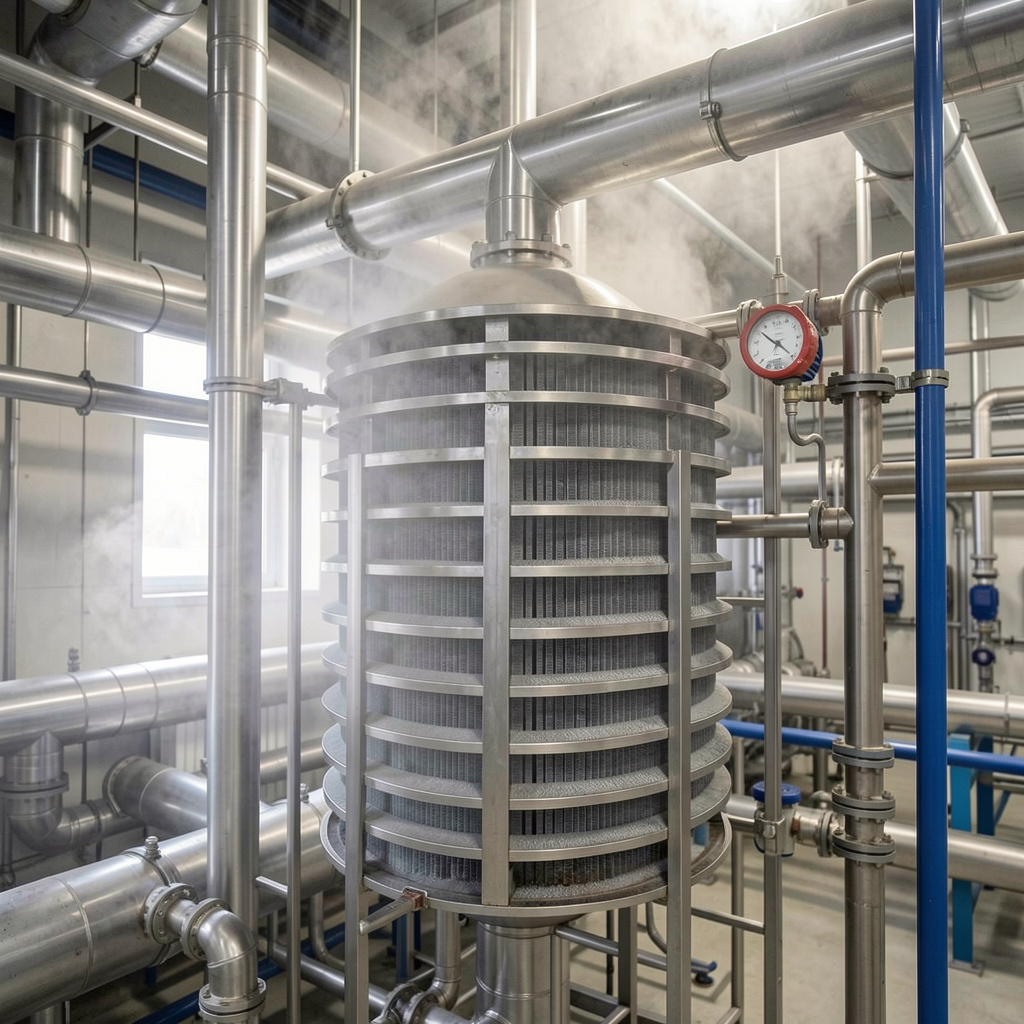
High-load gas–liquid systems impose non-trivial separation demands. Elevated superficial velocities, broad droplet size distributions, and high liquid loading collectively degrade conventional separation performance. Under these conditions, a properly specified mesh pad mist eliminator provides a mechanically robust and thermodynamically consistent method for droplet disengagement, limiting entrainment losses and maintaining downstream process integrity.
In high-throughput operations, separation efficiency is not a secondary metric—it is a governing constraint. Systems must sustain droplet capture without imposing excessive pressure drop or inducing flow maldistribution. Engineered mist eliminator pads address this requirement by balancing fiber surface area, void fraction, and hydraulic resistance, ensuring stable operation under variable process intensities.
What Are Mesh Pad Mist Eliminators?
Mesh pad mist eliminators, also referred to as mesh pads or mist eliminator pads, are structured assemblies of knitted or woven metallic and polymeric filaments designed for vapor–liquid phase separation. Their geometry is defined by a high specific surface area and controlled porosity, enabling efficient droplet capture across a wide operating envelope.
As the vapor phase traverses the mesh, entrained liquid droplets interact with filament surfaces. This interaction promotes droplet adhesion and subsequent growth, ultimately resulting in gravitational disengagement. The design objective is straightforward: maximize contact probability while maintaining acceptable system hydraulics.
Mechanisms of Droplet Separation
The separation performance of a mesh pad mist eliminator is governed by three coupled mechanisms:
- Inertial impaction: Droplets with sufficient mass deviate from gas streamlines and collide with mesh filaments.
- Direct interception: Smaller droplets following flow paths contact fibers when their radius intersects the filament boundary.
- Coalescence: Captured droplets merge to form larger liquid masses with increased settling velocity.
This multi-mechanism capture model is what enables mist eliminator pads to handle both fine mists and larger entrained droplets within the same unit operation. The coalescence step is particularly critical in high-load environments, where fine droplets dominate and require transformation into separable sizes.
Performance Under High-Load Conditions
High-load environments amplify two primary constraints: insufficient residence time and excessive liquid flux. Elevated gas velocities reduce droplet–fiber interaction time, while high liquid loading increases re-entrainment risk.
A correctly engineered mesh pad mist eliminator mitigates these effects by:
- Increasing effective collision frequency through optimized mesh density
- Promoting rapid coalescence to prevent droplet re-entrainment
- Maintaining a uniform velocity profile to avoid localized flooding
Failure to address these factors results in downstream contamination, compressor damage, fouling of heat transfer surfaces, and non-compliance with emission limits.
How Mesh Pad Mist Eliminators Improve Separation Efficiency
From a process engineering standpoint, mesh pad mist eliminators improve separation efficiency by increasing the statistical probability of droplet capture per unit volume of gas processed.
Key performance contributions include:
- High surface area contact: Dense filament networks enhance interception efficiency
- Controlled coalescence dynamics: Accelerates droplet growth into drainable sizes
- Low pressure drop design: Preserves system energy efficiency while maintaining throughput
- Configurability: Tailored mesh pads (density, thickness, material) align with specific vapor loads and chemical environments
In high-load systems, where fine droplet carryover is prevalent, these factors collectively determine whether separation performance remains stable or degrades under stress.
Critical Design and Operating Parameters
The effectiveness of a mesh pad mist eliminator is contingent on disciplined engineering design and process alignment:
- Mesh density and pad thickness: Directly influence efficiency–pressure drop tradeoff
- Gas velocity (superficial and local): Governs residence time and re-entrainment thresholds
- Droplet size distribution: Defines capture difficulty and coalescence requirements
- Material compatibility: Metallic vs polymeric selection based on corrosion, ताप, and chemical exposure
- Installation geometry: Ensures uniform flow distribution and prevents bypassing
Neglect in any of these parameters will manifest as reduced separation efficiency or increased maintenance frequency.
Industrial Relevance and Operational Impact
In applied settings chemical processing, hydrocarbon handling, power generation, and thermal systems mist eliminator pads function as protective and efficiency-critical components.
Operational advantages include:
- Reduction in liquid carryover and associated product loss
- Protection of downstream equipment from corrosion, fouling, and erosion
- Stabilization of process conditions in sensitive unit operations
- Compliance with emission and environmental discharge standards
The simplicity of the mesh pad architecture also supports predictable maintenance cycles and straightforward replacement strategies, which is non-trivial in continuous processing environments.
Precision-Engineered Separation for Demanding Systems
Sustained droplet separation in high-load service is not achieved through generic hardware. It requires a rigorously specified mesh pad mist eliminator aligned with process thermodynamics, fluid properties, and mechanical constraints.
Kimre ™ Clean Air technologies approaches mist elimination from a performance-first engineering perspective, delivering mist eliminator pads and mesh pads designed for durability, optimized coalescence behavior, and consistent hydraulic performance. Whether applied in standard configurations or custom-engineered systems, the objective remains unchanged: maximize separation efficiency without compromising system stability.

