
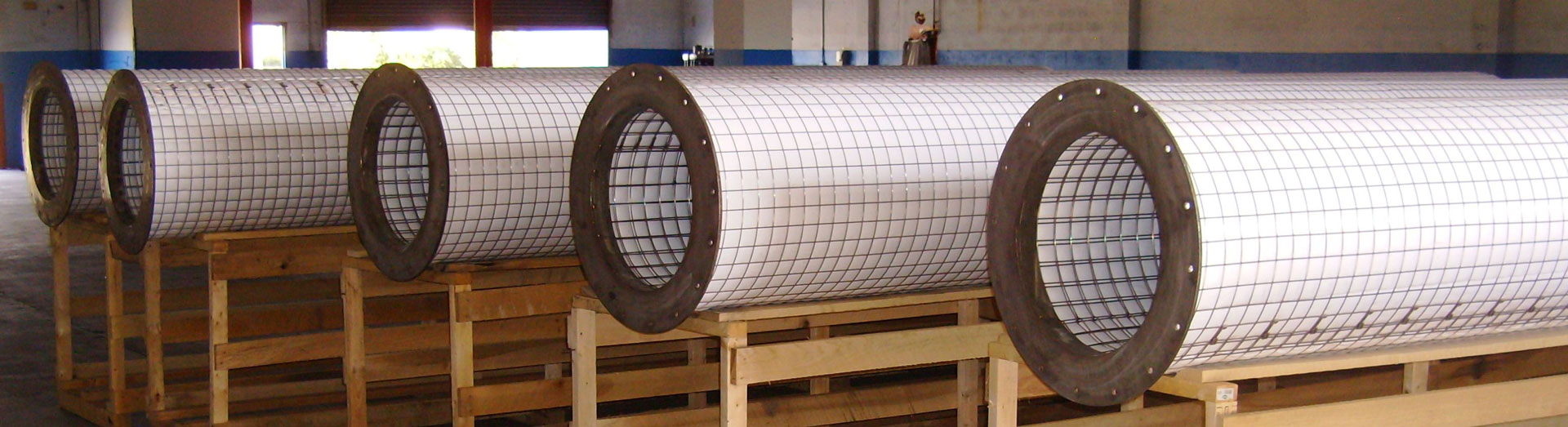
Industrial systems handling sulfuric acid do not fail from a single large oversight, they degrade from persistent exposure to fine acid mist, submicron droplets, and corrosive vapor phases that evade conventional separation methods. Left unmanaged, these emissions compromise air quality, accelerate material degradation, and introduce variability into otherwise controlled processes. A properly specified sulfuric acid filter, integrated with a sulfuric acid scrubber and high-efficiency sulfuric acid mist eliminators, addresses these issues at their source with measurable impact on both environmental and operational performance.
What Is a Sulfuric Acid Filter?
A sulfuric acid filter is not a generic particulate device; it is a precision-engineered separation system designed to remove fine sulfuric acid aerosols and mist from industrial gas streams. These systems are routinely applied in sulfuric acid production units, fertilizer plants, metal finishing lines, and chemical processing facilities where aerosolized acid is inherent to the operation.
Unlike inertial separators or basic demisters, a sulfuric acid filter is designed to capture submicron droplets through fiber-bed filtration and coalescence mechanisms. In most process configurations, it operates downstream of a sulfuric acid scrubber, forming a final-stage polishing barrier that ensures compliance-level emission control.
Mechanism of Operation: Coalescence and Capture Efficiency
From a transport phenomena perspective, the performance of a sulfuric acid filter is governed by diffusion, interception, and inertial impaction within a dense fibrous medium. As contaminated gas passes through the filter bed:
- Submicron sulfuric acid mist droplets collide with fiber surfaces
- Droplets coalesce into larger agglomerates
- Increased mass enables gravitational drainage from the media
This coalescing filtration mechanism is what differentiates sulfuric acid mist eliminators from conventional filters. Properly designed systems achieve high collection efficiency across a wide droplet size distribution, including particles well below 1 micron.
When paired with a sulfuric acid scrubber, which primarily removes soluble gases and larger droplets through liquid absorption, the combined system provides comprehensive removal of both vapor-phase and aerosol-phase contaminants.
Air Quality Control and Environmental Performance
The primary environmental function of a sulfuric acid filter is the reduction of acid mist emissions that contribute to visible plume formation, acid deposition, and regulatory non-compliance. Fine sulfuric acid aerosols are particularly problematic due to their persistence and mobility in the atmosphere.
Effective sulfuric acid mist elimination results in:
- Elimination of visible stack emissions
- Reduction in ambient acid concentration
- Improved compliance with air quality standards
- Lower risk of downstream environmental impact
Internally, improved air quality reduces occupational exposure risks and mitigates acid condensation on structural and mechanical components.
Process Efficiency and Asset Protection
From a process engineering standpoint, uncontrolled sulfuric acid mist is a contamination vector. It deposits on heat exchangers, ducts, fans, and instrumentation, initiating corrosion cycles and fouling layers that degrade thermal and mechanical efficiency.
A high-efficiency sulfuric acid filter:
- Prevents acid carryover into downstream equipment
- Reduces corrosion rates in metallic systems
- Maintains heat transfer efficiency
- Stabilizes pressure drop and flow characteristics
The result is not only improved equipment longevity but also tighter control over process variables, critical in continuous operations where variability translates directly to yield loss or off-spec production.
Key Design and Operating Parameters
The performance envelope of a sulfuric acid filtration system is defined by several interdependent variables:
- Gas velocity and residence time: Directly influence droplet capture probability
- Temperature and acid concentration: Affect vapor condensation and material compatibility
- Droplet size distribution: Determines filtration mechanism dominance
- Fiber bed density and media selection: Control efficiency versus pressure drop
- Flow distribution uniformity: Prevents channeling and localized failure
Neglecting any of these parameters during design or operation will reduce overall system efficiency, regardless of the nominal specification of the sulfuric acid mist eliminators.
Operational and Economic Considerations
The installation of a sulfuric acid filter is not solely an environmental control measure—it is a cost-containment strategy. Facilities operating without adequate mist elimination typically incur:
- Elevated maintenance frequency
- Premature equipment replacement
- Process inefficiencies due to fouling
- Loss of recoverable acid product
By contrast, a well-integrated system combining a sulfuric acid scrubber and sulfuric acid filter reduces total cost of ownership through improved reliability and reduced downtime.
Integrated Filtration for Industrial Reliability
Effective control of sulfuric acid emissions requires more than a single device; it requires a coordinated system approach. The sulfuric acid scrubber addresses bulk removal, while sulfuric acid mist eliminators and fiber-bed filtration systems provide high-efficiency polishing of residual aerosols.
Kimre™ Clean Air Technology designs engineered filtration systems that are designed with this integration in mind, delivering consistent performance under high-load, high-temperature industrial conditions. Their sulfuric acid filters and mist eliminators are developed to maintain efficiency where conventional systems decline—under fine particle loading and demanding chemical environments.
For facilities prioritizing emission control, equipment protection, and process stability, the implementation of a properly engineered sulfuric acid filtration system is not optional—it is fundamental.

