Selecting an industrial air filtration partner involves far more than comparing equipment specifications or evaluating the speed of a quotation. The most effective filtration systems are the result of sound process engineering, application expertise, and a thorough understanding of the operating environment.
An experienced filtration partner begins by evaluating the process before recommending a solution. Key considerations include contaminant type and concentration, particle or droplet size distribution, gas composition, process temperature, humidity, airflow volume, chemical compatibility, allowable pressure drop, emissions requirements, and maintenance objectives. These variables determine which technologies will provide the highest collection efficiency, long-term reliability, and lowest life-cycle cost.
Every industrial process presents unique contaminant control challenges. Chemical processing, metal processing, metal finishing, chrome plating, paint finishing, pharmaceutical manufacturing, semiconductor manufacturing, and machining operations each generate different combinations of particulate, aerosols, acid mist, condensable vapors, and corrosive gases. An effective filtration strategy must be engineered specifically for the application rather than selected from a standard equipment catalog.
The most successful filtration partners help facilities avoid three common engineering mistakes.
First, selecting equipment based solely on technology type rather than process requirements. Mist eliminators, fiber bed filters, scrubbers, coalescers, cartridge collectors, and particulate filtration systems each serve distinct purposes. Their effectiveness depends on matching the technology to the contaminant characteristics and operating conditions.
Second, overlooking the impact of airborne contaminants on downstream equipment. Fine particulate, acid mist, and corrosive vapors can migrate throughout the process, accelerating corrosion, fouling fans and heat exchangers, increasing pressure losses, and reducing the reliability of critical plant assets.
Third, focusing on initial capital cost instead of long-term operating performance. A filtration system that is difficult to maintain, susceptible to fouling, chemically incompatible with the process, or prone to excessive pressure drop can significantly increase maintenance costs, energy consumption, and unplanned downtime over its service life.
At Kimre™ Clean Air Technology, every filtration solution begins with engineering. Our team evaluates the complete process using application expertise and decades of experience in contaminant control to develop engineered filtration solutions for demanding industrial applications. The objective is not simply to supply equipment—it is to develop an engineered solution that delivers reliable performance, protects downstream assets, and minimizes total cost of ownership.
Choose a filtration partner that understands your process before recommending a product. Kimre™ Clean Air Technology works closely with industrial facilities to engineer contaminant control solutions that optimize collection efficiency, improve equipment reliability, support regulatory compliance, and maximize long-term operational performance.
Industrial Air Filtration for High-Performance Process Operations
Industrial air filtration is a critical component of process reliability and environmental control, enabling the effective removal of particulate matter, liquid aerosols, acid mists, condensable hydrocarbons, volatile organic compounds (VOCs), corrosive gases, and other airborne contaminants before they adversely impact process equipment, emissions performance, occupational exposure, or product integrity. Effective contaminant capture at the source minimizes fouling, corrosion, and deposition within process systems while preserving airflow characteristics, improving equipment reliability, and reducing maintenance frequency.
Selection of an industrial air filtration system requires a thorough evaluation of process-specific operating parameters rather than contaminant type alone. Key design considerations include particle size distribution, aerosol loading, gas-phase composition, volumetric flow rate, operating temperature, humidity, pressure differential limitations, chemical compatibility, and target collection efficiency. Filtration technologies that perform effectively for dry particulate removal may be unsuitable for submicron liquid aerosols, acid mists, condensable vapors, or chemically aggressive gas streams. Consequently, filtration media and separator configurations should be engineered to match the physical and chemical characteristics of the process stream.
Key Takeaway: High-performance industrial air pollution control systems are engineered to optimize contaminant removal while maintaining process efficiency, equipment longevity, regulatory compliance, and worker safety. Kimre™ Clean Air Technology develops application-specific filtration solutions based on fundamental transport phenomena, process conditions, and performance requirements, enabling long-term operational reliability in demanding industrial environments. For facilities evaluating industrial air filtration technologies, a process-engineered approach provides a more effective long-term solution than selecting equipment based solely on generalized filtration specifications.
Industrial Air Filtration: Engineering Considerations for Process Performance and Emissions Control
Air quality within an industrial facility often becomes a focus only after process performance begins to deteriorate. Particulate deposition accumulates on critical equipment, liquid aerosols foul process surfaces, objectionable odors increase, ventilation effectiveness declines, and recurring maintenance issues begin affecting production reliability and operating costs.
Industrial air filtration systems are designed to interrupt this cycle by removing airborne contaminants before they compromise process performance, equipment integrity, environmental compliance, or worker safety. Depending on the application, contaminants may include coarse and fine particulate matter, smoke, liquid aerosols, oil mist, acid mist, condensable vapors, volatile organic compounds (VOCs), corrosive gases, hazardous air pollutants (HAPs), biological contaminants, and odor-causing compounds.
For industrial facilities, the objective extends well beyond improving ambient air quality. Effective air pollution control supports process stability, protects capital equipment from fouling and corrosion, maintains designed airflow characteristics, improves product quality, extends equipment service life, minimizes unplanned maintenance, and helps facilities meet increasingly stringent occupational and environmental regulatory requirements.
The key point is this: industrial air filtration is not simply an environmental control measure—it is a process engineering decision that directly influences plant reliability, operational efficiency, asset longevity, and total lifecycle cost.
The first step in system design is identifying the physical and chemical characteristics of the contaminant stream. A comprehensive process evaluation should characterize contaminant morphology, particle size distribution, aerosol loading, gas composition, moisture content, operating temperature, volumetric flow rate, pressure-drop constraints, and required collection efficiency. These process variables ultimately determine the most appropriate separation technology and filtration media.
Selecting an air pollution control system without first understanding these operating parameters frequently results in reduced collection efficiency, excessive pressure loss, accelerated media loading, increased maintenance requirements, and higher operating costs.
Industrial facilities therefore evaluate a range of air filtration and separation technologies before finalizing system specifications. Available technologies include mechanical filtration, electrostatic precipitators (ESPs), HEPA and ULPA filtration, activated carbon adsorption systems, baghouse dust collectors, cartridge collectors, wet scrubbers, fiber-bed mist eliminators, mesh-pad mist eliminators, and hybrid multi-stage systems. Each technology operates through different particle capture mechanisms—including inertial impaction, interception, diffusion, electrostatic attraction, coalescence, adsorption, or absorption—and is optimized for specific contaminant characteristics and operating conditions.
For example, electrostatic precipitators are highly effective for collecting submicron particulate matter, smoke, and liquid aerosols while maintaining relatively low pressure losses, with properly engineered systems capable of achieving collection efficiencies exceeding 99%. Baghouse dust collectors remain the preferred technology for high-volume dry particulate applications and routinely achieve particulate removal efficiencies greater than 99.9% when designed for the appropriate particle size distribution and dust loading.
Not sure where to begin? Describe your process conditions and the airborne contaminants generated by your operation, and Kimre™ Clean Air Technology engineers can recommend a filtration solution tailored to your process requirements, performance objectives, and operating environment.
Why Air Filtration Decisions Influence Process Performance
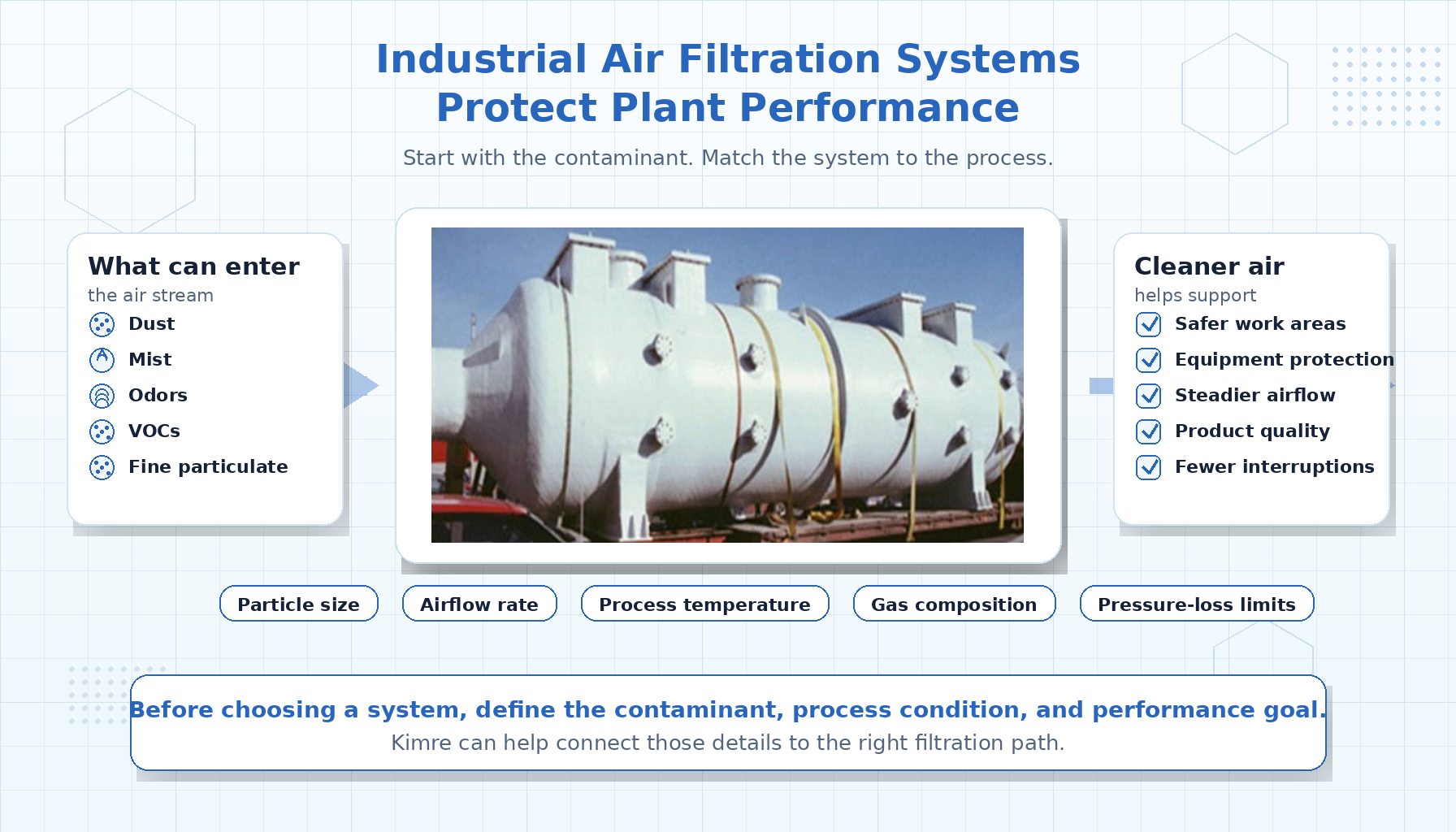
Airborne contaminants rarely remain confined to the airstream. Once dispersed throughout a facility, particulate matter, liquid aerosols, condensable vapors, and corrosive gases can deposit on ductwork, heat exchangers, rotating equipment, instrumentation, and process surfaces. The resulting fouling, corrosion, airflow restriction, and residue accumulation can degrade system performance, increase energy consumption, accelerate equipment wear, and drive unplanned maintenance.
The impact extends beyond equipment reliability. Excess moisture and liquid aerosols can promote corrosion, impair pneumatic and compressed air systems, and contribute to process instability. In controlled manufacturing environments, ultrafine particulate matter can compromise product quality, clean manufacturing requirements, and occupational health objectives.
For these reasons, industrial air filtration should be considered an integral component of process engineering rather than a downstream environmental compliance measure. Ineffective contaminant control frequently manifests as increased maintenance costs, reduced production efficiency, equipment failures, elevated operating expenses, inconsistent product quality, regulatory challenges, and unplanned downtime.
Because every industrial process generates a unique emissions profile, filtration strategies must be application specific. Metal processing operations may produce fine particulate, acid mist, metal fumes, and corrosive gas streams associated with pickling, electroplating, and surface finishing. Pharmaceutical and semiconductor manufacturing require stringent control of ultrafine particulate matter to maintain clean manufacturing environments. Paint finishing operations depend on uniform airflow and efficient overspray capture to preserve coating quality. Chemical processing facilities often require removal of volatile organic compounds (VOCs), acid gases, and condensable vapors, while metalworking operations commonly demand high-efficiency capture of oil mist, coolant aerosols, and fine metallic particulates.
Consequently, filtration system selection should begin with a comprehensive characterization of the process stream rather than the selection of a predefined equipment type. Critical design parameters include contaminant composition, particle size distribution, aerosol loading, gas chemistry, volumetric flow rate, operating temperature, humidity, collection efficiency requirements, and allowable system pressure drop.
The appropriate air filtration or air pollution control technology depends on these process variables. Mechanical filtration technologies are commonly used for dry particulate removal, coalescing filtration separates dispersed liquid droplets from compressed air and gas streams, activated carbon adsorption systems remove VOCs and odorous compounds, and HEPA and ULPA filtration systems provide exceptionally high removal efficiencies for submicron particulate matter. More complex industrial applications may require engineered, multi-stage systems that integrate complementary separation technologies to achieve performance objectives while minimizing lifecycle operating costs.
Facilities evaluating air filtration solutions should first define the contaminants requiring removal before selecting a filtration technology. A contaminant-driven engineering approach produces more effective, reliable, and economical system designs than selecting equipment based solely on product category or generalized performance claims.
Experiencing particulate buildup, liquid aerosol deposition, objectionable odors, or declining airflow performance? Consult Kimre's engineering team to evaluate your process emissions and identify a filtration solution engineered for your specific operating conditions before contaminant-related issues impact reliability, productivity, or maintenance costs.
How Cleaner Air Protects Equipment and Uptime
Air quality issues rarely appear as a single failure event—they reveal themselves through recurring maintenance trends and declining equipment performance.
The warning signs are often subtle at first. Fans require more frequent maintenance. Deposits accumulate within ductwork and process equipment. Heat exchangers experience reduced thermal efficiency. Pressure losses begin to increase, and the same assets require repeated cleaning or repair. Over time, equipment operates less efficiently, experiences accelerated wear, and becomes increasingly susceptible to unplanned downtime.
In many cases, these are not isolated mechanical issues—they are symptoms of contaminant carryover within the process air stream.
Fine particulate, oil aerosols, acid mists, and corrosive vapors can deposit on critical equipment surfaces, promoting corrosion, fouling, restricted airflow, reduced heat transfer, increased energy consumption, and premature equipment degradation. A properly engineered filtration system intercepts these contaminants before they reach downstream assets, improving equipment reliability, reducing maintenance requirements, and extending service life.
For this reason, industrial air filtration should be viewed as an integral component of process reliability rather than a secondary environmental control system. Effective contaminant control directly influences equipment availability, maintenance frequency, process efficiency, and overall plant uptime.
When maintenance teams repeatedly address the same fouling, corrosion, or airflow restrictions, the root cause may extend beyond the equipment itself. The process exhaust stream may be transporting contaminants that continue to compromise downstream performance despite repeated repairs.
Rather than treating the symptoms, facilities should evaluate how improved air filtration can protect equipment from particulate, oil mist, acid mist, and corrosive process emissions. This shifts the discussion beyond emissions compliance to asset protection, operational continuity, and life-cycle cost reduction.
A comprehensive filtration assessment should address key engineering considerations, including:
- What contaminants are present within the process air stream?
- What are their physical and chemical characteristics?
- Where are contaminants entering the system?
- Are they particulate, mist, aerosol, condensable, corrosive, or gaseous?
- Is excessive pressure drop reducing system performance?
- Are filters fouling prematurely due to contaminant loading?
- Is contaminant carryover reaching downstream equipment?
- Are corrosion, fouling, or deposition occurring within ducts, fans, heat exchangers, or process vessels?
The objective is not to specify a larger filtration system—it is to engineer the right solution for the application's operating conditions, contaminant characteristics, and performance objectives.
Kimre™ Clean Air Technology engineers contaminant control solutions for demanding industrial applications, including fiber bed mist eliminators, B-GON® mist eliminators, drift eliminators, and engineered scrubber and tower packing. Our technologies are designed to capture submicron aerosols, control acid mist and chemical emissions, reduce liquid carryover, improve gas stream purification, and protect critical process equipment while supporting long-term operational reliability.
Recurring fouling, corrosion, or equipment failures are often indicators of an upstream contaminant control issue. Kimre partners with industrial facilities to identify the root cause, optimize filtration performance, and develop engineered solutions that improve equipment protection, process efficiency, and long-term plant reliability.
Why Metal Processing Requires Engineered Air Pollution Control
Metal processing facilities operate in some of the most demanding industrial environments, where airborne contaminants are significantly more complex than conventional dust loading.
Process operations such as smelting, pickling, galvanizing, chrome plating, anodizing, steel pickling, metal finishing, and chemical surface treatment generate a combination of fine particulate, acid mist, aerosols, condensable vapors, and corrosive process gases. Each contaminant behaves differently within the exhaust stream and requires a filtration technology engineered for its specific physical and chemical characteristics.
This distinction is critical.
Particulate filtration is designed to capture solid particles, while mist eliminators remove liquid aerosols and droplets. Corrosive vapors often require gas absorption or wet scrubbing technologies. In many metal processing applications, no single technology can effectively address the full contaminant profile. Instead, the highest-performing systems integrate multiple technologies to provide comprehensive emissions control while maintaining process reliability.
Effective industrial air pollution control begins with understanding the process itself. Particle and droplet size distribution, gas chemistry, temperature, humidity, airflow, contaminant loading, and allowable pressure drop all influence the selection of the appropriate filtration technology. A system engineered around these operating conditions will consistently outperform a standard, off-the-shelf solution.
When evaluating emission control strategies for metal processing applications, the key question extends beyond collection efficiency. Facilities should also evaluate whether the system can maintain that performance under continuous exposure to elevated temperatures, corrosive chemistry, saturated gas streams, and high contaminant loading. Long-term reliability is determined not only by how effectively contaminants are captured, but by how consistently the system performs throughout its service life.
Kimre™ Clean Air Technology engineers filtration solutions specifically for these challenging operating environments. B-GON® Mist Eliminators utilize interlaced thermoplastic media to efficiently remove fine liquid droplets while maintaining exceptionally low pressure drop in highly corrosive applications. Kimre Fiber Bed Mist Eliminators are engineered to capture submicron aerosols with industry-leading efficiency in demanding chemical processes, including sulfuric acid, nitric acid, fertilizer, chlor-alkali, and metal processing applications. Kimre also designs drift eliminators, scrubber internals, liquid coalescers, and tower packing that reduce liquid carryover, improve gas stream purification, and protect downstream process equipment.
Selecting the wrong air pollution control technology can introduce significant long-term operating costs, including:
- Increased pressure drop and energy consumption
- Premature fouling of filtration equipment
- Reduced system airflow and process efficiency
- Fan overload and mechanical wear
- Corrosion of ductwork and downstream equipment
- Frequent maintenance interventions
- Unplanned production shutdowns
- Higher life-cycle operating costs
- Increased environmental compliance risk
Beyond emissions control, engineered filtration systems protect critical plant assets by minimizing contaminant deposition on fans, heat exchangers, ductwork, and other downstream equipment. This reduces corrosion and fouling while improving equipment reliability, extending service life, and maximizing plant uptime.
Successful contaminant control in metal processing requires more than selecting a filter—it requires engineering a solution around the process. Kimre™ Clean Air Technology partners with industrial facilities to develop application-specific air pollution control systems that maximize collection efficiency, protect valuable equipment, and deliver long-term operational performance in the industry's most demanding environments.
How to Compare Industrial Air Filtration Partners
Selecting an industrial air filtration partner involves far more than comparing equipment specifications or evaluating the speed of a quotation. The most effective filtration systems are the result of sound process engineering, application expertise, and a thorough understanding of the operating environment.
An experienced filtration partner begins by evaluating the process before recommending a solution. Key considerations include contaminant type and concentration, particle or droplet size distribution, gas composition, process temperature, humidity, airflow volume, chemical compatibility, allowable pressure drop, emissions requirements, and maintenance objectives. These variables determine which technologies will provide the highest collection efficiency, long-term reliability, and lowest life-cycle cost.
Every industrial process presents unique contaminant control challenges. Chemical processing, metal processing, metal finishing, chrome plating, paint finishing, pharmaceutical manufacturing, semiconductor manufacturing, and machining operations each generate different combinations of particulate, aerosols, acid mist, condensable vapors, and corrosive gases. An effective filtration strategy must be engineered specifically for the application rather than selected from a standard equipment catalog.
The most successful filtration partners help facilities avoid three common engineering mistakes.
First, selecting equipment based solely on technology type rather than process requirements. Mist eliminators, fiber bed filters, scrubbers, coalescers, cartridge collectors, and particulate filtration systems each serve distinct purposes. Their effectiveness depends on matching the technology to the contaminant characteristics and operating conditions.
Second, overlooking the impact of airborne contaminants on downstream equipment. Fine particulate, acid mist, and corrosive vapors can migrate throughout the process, accelerating corrosion, fouling fans and heat exchangers, increasing pressure losses, and reducing the reliability of critical plant assets.
Third, focusing on initial capital cost instead of long-term operating performance. A filtration system that is difficult to maintain, susceptible to fouling, chemically incompatible with the process, or prone to excessive pressure drop can significantly increase maintenance costs, energy consumption, and unplanned downtime over its service life.
At Kimre™ Clean Air Technology, every filtration solution begins with engineering. Our team evaluates the complete process using application expertise and decades of experience in contaminant control to develop engineered filtration solutions for demanding industrial applications. The objective is not simply to supply equipment—it is to develop an engineered solution that delivers reliable performance, protects downstream assets, and minimizes total cost of ownership.
Choose a filtration partner that understands your process before recommending a product. Kimre works closely with industrial facilities to engineer contaminant control solutions that optimize collection efficiency, improve equipment reliability, support regulatory compliance, and maximize long-term operational performance.
What the Final Filtration Review Should Clarify
A comprehensive filtration review should eliminate uncertainty by providing a clear, engineering-based path toward the most effective contaminant control solution.
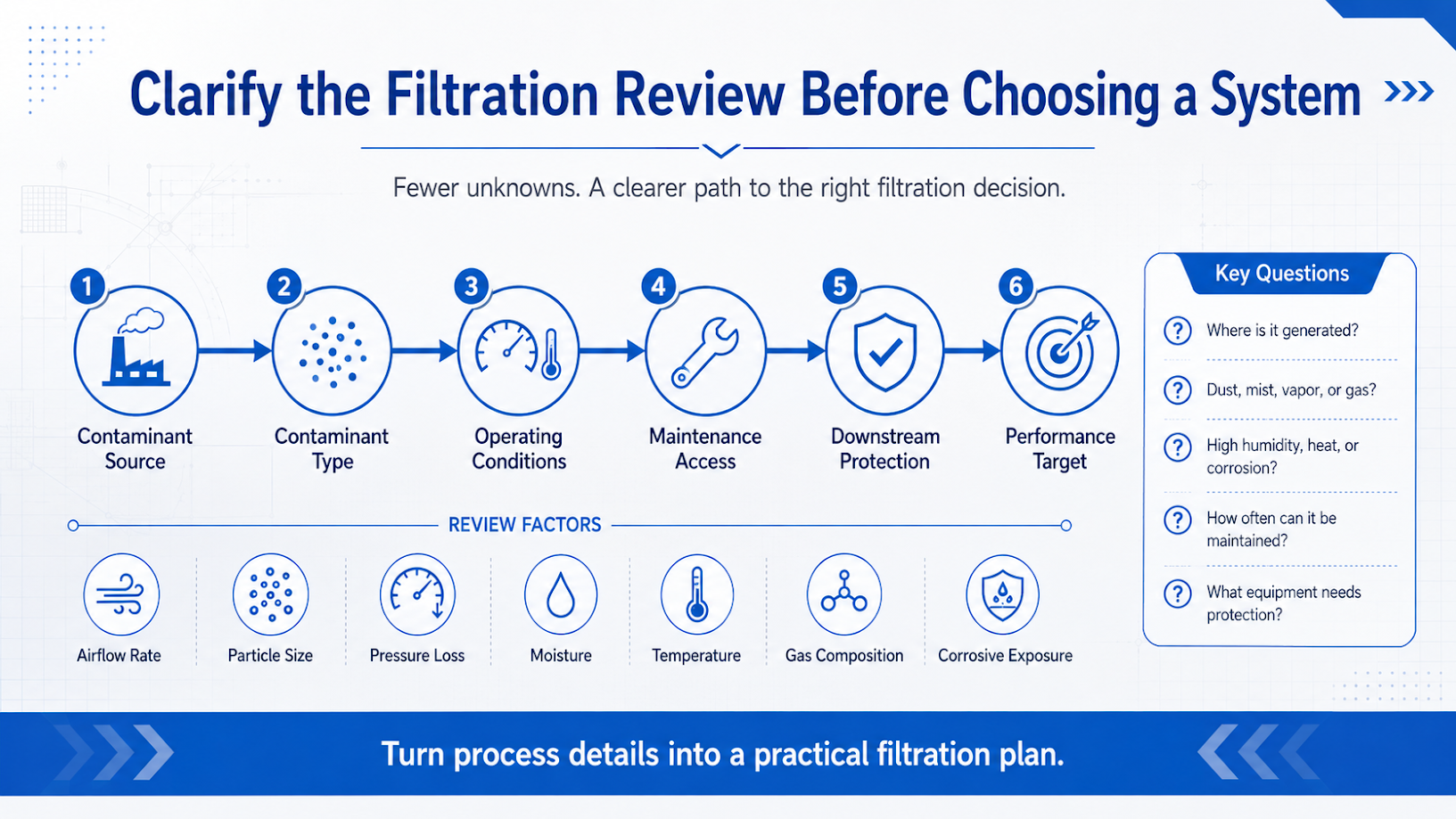
Before a filtration system is specified, the engineering team should have a complete understanding of the process exhaust stream, including the types of contaminants present, where they are generated, how they behave throughout the process, and which separation technologies are best suited to achieve the required performance. This evaluation forms the foundation for a filtration system that delivers reliable operation, regulatory compliance, and long-term process efficiency.
A thorough review should evaluate the critical operating parameters that directly influence system performance, including airflow rate, contaminant concentration, particle and droplet size distribution, gas composition, temperature, humidity, corrosivity, allowable pressure drop, and process variability. These engineering considerations are essential when selecting the appropriate filtration technology, as mist eliminators, fiber bed filters, scrubbers, coalescers, particulate collectors, and adsorption systems are each designed to address specific contaminant characteristics and operating environments.
This evaluation is important because an air pollution control system is not simply a capital purchase—it becomes an integral component of the plant's operating reliability.
A system that is difficult to maintain increases labor requirements and operating costs. A technology that is not matched to the contaminant profile may fail to achieve the required collection efficiency. Excessive pressure drop can increase energy consumption and reduce process performance, while incorrect material selection can accelerate corrosion and shorten equipment life in chemically aggressive environments. Likewise, systems designed to address only a single contaminant may leave facilities struggling with unresolved emissions when multiple particulate, mist, and vapor-phase pollutants are present.
An effective engineering review should provide clear answers to several critical questions:
- What contaminants are generated throughout the process?
- Are the contaminants particulate, mist, aerosol, condensable vapor, corrosive gas, or a combination of multiple phases?
- What are the particle and droplet size distributions?
- What process temperatures, humidity levels, and chemical conditions will the system encounter?
- What pressure drop limitations and airflow requirements must be maintained?
- Which downstream equipment requires protection from contaminant carryover?
- What collection efficiency, emissions limits, and operational performance objectives must the system achieve?
By answering these questions early in the design process, facilities can make informed engineering decisions based on actual operating conditions rather than selecting equipment from a generalized product category. The result is a filtration system engineered to maximize contaminant removal, improve equipment reliability, minimize maintenance requirements, and reduce total life-cycle cost.
The final filtration review should provide confidence—not compromise. At Kimre™ Clean Air Technology, we work with customers to evaluate their complete process, identify the appropriate contaminant control strategy, and engineer filtration solutions that deliver long-term performance, equipment protection, and operational reliability.
When a Standard Filtration System Is Not Enough
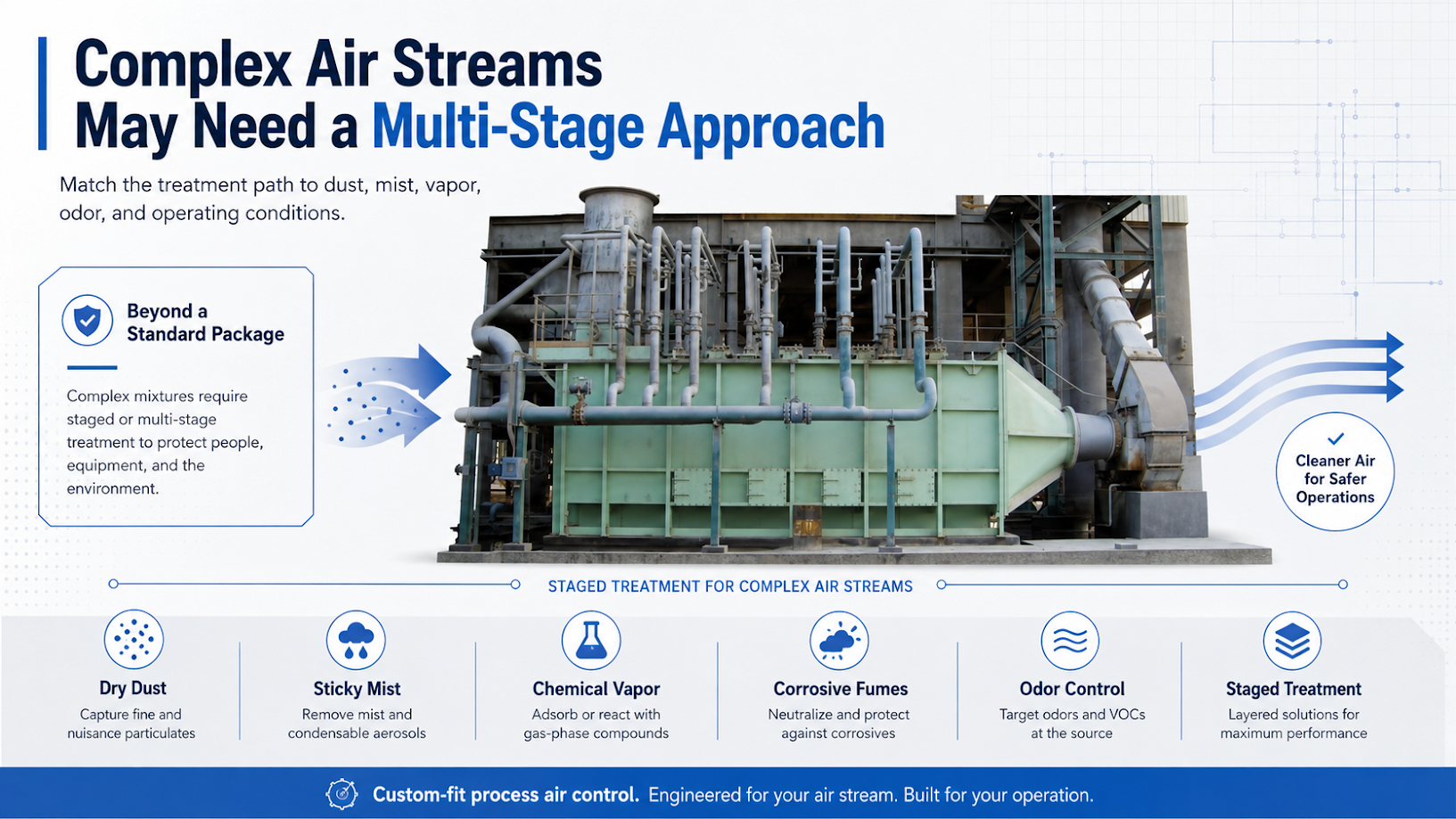
Not all industrial exhaust streams present the same contaminant control challenges. While some applications involve relatively straightforward particulate removal, many industrial processes generate complex mixtures of dust, liquid aerosols, acid mist, condensable vapors, corrosive gases, and volatile organic compounds (VOCs). As contaminant profiles become more complex, selecting a standard filtration package may not provide the performance or reliability required for long-term operation.
A dry particulate application requires a fundamentally different approach than a process generating submicron aerosols, liquid mists, corrosive chemical vapors, or multiphase contaminants. Each contaminant behaves differently within the gas stream and requires a technology specifically engineered for its physical and chemical properties. Effective air pollution control begins with understanding the complete contaminant profile—not simply addressing the most visible emissions.
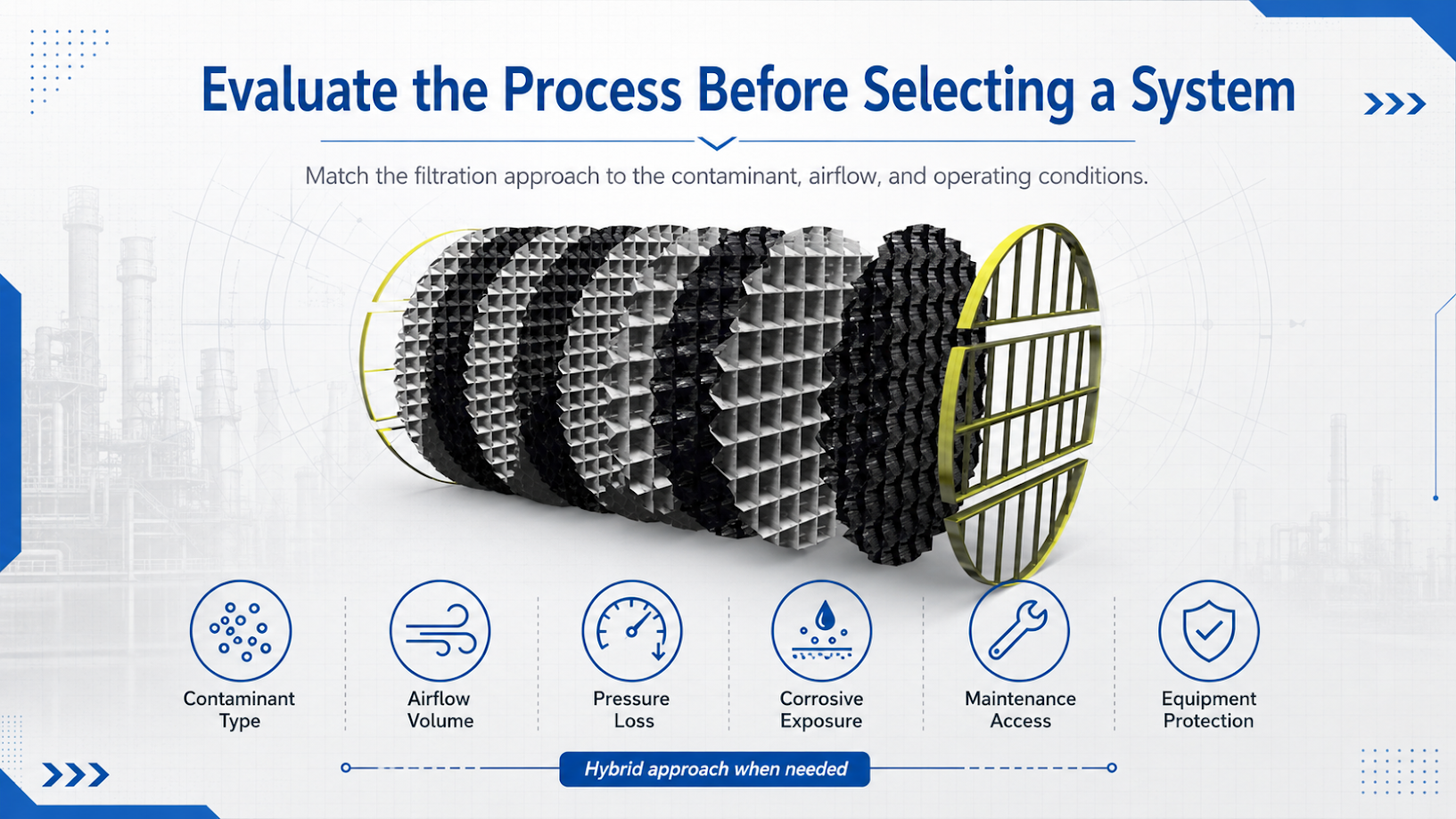
In many industrial applications, the highest-performing solution combines multiple contaminant control technologies into a staged treatment system. Depending on the process requirements, this may include particulate filtration, fiber bed mist elimination, mesh pad mist eliminators, wet scrubbing, liquid coalescing, gas absorption, or activated carbon adsorption. Each technology performs a specific function, and together they provide comprehensive control across a broad range of contaminant types.
For example, wet scrubbers are commonly used to remove particulate matter, soluble gases, and acid-forming compounds from process exhaust streams while cooling and conditioning the gas stream. Activated carbon systems are effective for removing many volatile organic compounds (VOCs), organic vapors, and odor-causing compounds. Fiber bed mist eliminators are engineered for high-efficiency removal of fine and submicron liquid aerosols, while mesh pad and coalescing technologies efficiently remove larger liquid droplets and reduce liquid carryover.
Selecting a filtration system based solely on visible dust can leave significant contaminants untreated. Many industrial processes simultaneously generate particulate, acid mist, condensable vapors, and corrosive gases that continue to contribute to equipment fouling, corrosion, reduced product quality, odor concerns, environmental compliance issues, and reduced process reliability if only one contaminant phase is addressed.
For facilities managing complex process emissions, a staged contaminant control strategy often provides the most effective long-term solution. Individual treatment stages can be engineered to remove coarse particulate, fine aerosols, acid mist, condensable vapors, or gas-phase contaminants in sequence, allowing each technology to operate within its optimum performance range. The appropriate system configuration should always be determined by the process conditions, contaminant characteristics, and performance objectives—not by a standardized equipment package.
Complex exhaust streams require engineered contaminant control solutions—not one-size-fits-all filtration systems. At Kimre™ Clean Air Technology, we evaluate the complete process environment to develop integrated filtration solutions that maximize collection efficiency, protect downstream equipment, support regulatory compliance, and deliver long-term operational reliability.
How Filtration Supports Safety, Compliance, and Operational Reliability
Industrial air quality has a direct impact on worker safety, environmental compliance, and overall plant performance. Airborne contaminants that are not effectively controlled can affect far more than emissions—they influence equipment reliability, workplace conditions, maintenance requirements, and long-term operating costs.
Different contaminants create different operational challenges. Fine particulates can accumulate within ductwork, process equipment, and ventilation systems, increasing pressure drop, reducing airflow, and decreasing energy efficiency. Oil mist and liquid aerosols can deposit on equipment surfaces, affecting workplace conditions, increasing maintenance requirements, and contributing to equipment performance issues. Acid mist, corrosive vapors, and high-moisture exhaust streams can accelerate corrosion of process equipment, ductwork, fans, and instrumentation while reducing the service life of critical assets. In applications requiring controlled environments, airborne contaminants can also compromise product quality and process integrity.
For these reasons, industrial air pollution control systems should be evaluated proactively rather than after operational or compliance issues develop. An engineered filtration strategy helps minimize contaminant exposure, protect personnel, preserve equipment, and maintain consistent process performance throughout the facility.
The need for effective contaminant control is especially critical in metal processing and chemical manufacturing environments. Operations such as pickling, chrome plating, surface finishing, metal processing, and chemical manufacturing generate combinations of fine particulate, acid mist, aerosols, and corrosive gases that require specialized treatment technologies. Without effective control, these contaminants can contribute to accelerated equipment degradation, increased maintenance, worker exposure concerns, and challenges in meeting environmental emissions requirements.
Effective air pollution control often requires multiple technologies working together. Depending on the application, particulate filtration, fiber bed mist eliminators, mist eliminators, wet scrubbers, liquid coalescers, and gas absorption systems may be integrated to address the complete contaminant profile. Just as importantly, the system must be engineered to withstand the operating conditions of the process, including airflow, contaminant loading, chemical composition, temperature, humidity, and maintenance requirements. Long-term performance depends not only on collection efficiency but also on durability, maintainability, and consistent operation under real process conditions.
Air quality issues rarely remain isolated. Contaminants that are not controlled at the source can migrate throughout the facility, affecting downstream equipment, increasing maintenance demands, reducing process efficiency, and creating broader operational and regulatory challenges.
Effective filtration is more than an environmental control measure—it is an investment in worker safety, equipment protection, regulatory compliance, and long-term plant reliability. At Kimre™ Clean Air Technology, we engineer contaminant control solutions that help industrial facilities maintain cleaner air, protect critical assets, and achieve dependable performance in the industry's most demanding operating environments.
What Makes Kimre the Right Partner for Complex Process Air Applications
Successful air pollution control begins with understanding the process—not selecting equipment from a catalog. Every industrial application presents unique operating conditions, contaminant characteristics, and performance requirements that demand an engineered approach.
For more than five decades, Kimre™ Clean Air Technology has partnered with industrial facilities across a wide range of demanding applications, including fertilizer production, sulfuric and nitric acid plants, chlor-alkali processing, metal finishing, chrome plating, anodizing, steel pickling, chemical manufacturing, refining, pulp and paper, and other process industries.
Our engineering team develops contaminant control solutions based on the complete operating environment rather than a single equipment specification. By understanding how contaminants are generated, how they behave within a process stream, and how they impact downstream equipment, Kimre designs solutions that deliver reliable performance throughout the operating life of the system.
Every filtration system is influenced by multiple process variables, including contaminant type, particle and droplet size distribution, gas composition, airflow volume, temperature, humidity, chemical compatibility, allowable pressure drop, maintenance requirements, equipment protection objectives, and emissions performance goals.
Understanding how these variables interact is essential to selecting the appropriate contaminant control technology and ensuring long-term system reliability.
Bringing the Filtration Decision Together
The most effective air pollution control systems are the result of sound engineering—not assumptions or standardized equipment selection. Successful contaminant control begins with a comprehensive evaluation of the process, the contaminants being generated, and the operating conditions that influence long-term system performance.
Every filtration decision should begin by identifying the contaminant source and fully characterizing the process exhaust stream. Contaminant type, particle and droplet size distribution, gas composition, temperature, humidity, chemical compatibility, airflow requirements, allowable pressure drop, maintenance considerations, emissions objectives, and downstream equipment protection requirements all play a critical role in determining the appropriate contaminant control strategy.
Only after these variables are understood can the proper technology be selected to achieve reliable performance throughout the life of the process.
The difference between purchasing filtration equipment and engineering an integrated contaminant control solution
Properly engineered filtration systems provide benefits that extend well beyond emissions control. By removing particulate, acid mist, aerosols, corrosive contaminants, and liquid carryover before they reach critical equipment, these systems help protect fans, ductwork, heat exchangers, process vessels, instrumentation, and other downstream assets.
The result is improved equipment reliability, reduced maintenance requirements, minimized corrosion and fouling, and more consistent process performance throughout the facility.
Engineered contaminant control also supports safer industrial operations by reducing airborne pollutant release while helping facilities achieve emissions objectives and maintain reliable process performance. When filtration systems are matched to actual operating conditions, they become an integral part of plant reliability rather than simply another piece of process equipment.
At Kimre™ Clean Air Technology, successful filtration begins with understanding the process. Our engineering team works closely with customers to evaluate contaminant characteristics, operating conditions, equipment protection requirements, and long-term performance objectives before recommending a solution.
This application-driven approach allows Kimre to develop engineered contaminant control systems that provide dependable performance, protect critical assets, and support long-term operational reliability.
The right filtration system is engineered around the process—not selected from a catalog. Whether your facility is managing acid mist, aerosols, corrosive contaminants, or complex industrial exhaust streams, Kimre provides engineered solutions designed to improve emissions performance, protect equipment, reduce.
Taking Control of Process Air
Air quality challenges rarely begin with a single equipment failure or compliance event. More often, they emerge gradually through recurring maintenance activities, increasing pressure drop, contaminant buildup, equipment fouling, corrosion, or declining process performance. These early indicators often signal that the existing contaminant control strategy no longer matches the demands of the process.
For this reason, selecting an industrial air filtration system should involve far more than comparing equipment specifications or obtaining the lowest quotation. Effective air pollution control requires a thorough understanding of the process, the contaminants being generated, and the operating conditions that influence long-term system performance.
Engineered industrial air filtration systems do more than capture airborne contaminants—they protect critical process equipment, improve operational reliability, support environmental compliance, and contribute to safer working conditions. In applications involving fine particulate, submicron aerosols, acid mist, corrosive vapors, condensable gases, or liquid carryover, the filtration technology must be specifically matched to the physical and chemical characteristics of the exhaust stream to achieve consistent, long-term performance.
Air pollution control should never be viewed as an auxiliary process. It is an integral part of plant reliability and operational efficiency. Properly engineered filtration systems help reduce contaminant deposition, minimize corrosion and fouling, extend equipment service life, improve airflow, reduce maintenance requirements, and support stable production by preventing small air quality issues from developing into costly operational disruptions.
Facilities evaluating industrial air filtration partners should look beyond equipment catalogs and quotation timelines. The most valuable partner is one that understands the complete process, evaluates contaminant characteristics and operating conditions, and develops an engineered solution tailored to the application's performance objectives. This process-first approach delivers greater reliability, lower life-cycle costs, and improved long-term system performance.
At Kimre™ Clean Air Technology, every filtration solution begins with engineering. We work closely with customers to understand their process, evaluate contaminant behavior, and design contaminant control systems that protect critical assets, optimize collection efficiency, and deliver dependable performance in demanding industrial environments.
Your process air should support your operation—not limit it. Partner with Kimre to develop engineered air pollution control solutions that improve equipment protection, enhance process reliability, maintain regulatory compliance, and provide long-term operational performance.
Talk to Kimre about what your facility needs to remove, protect, and control before choosing the next filtration solution.
Frequently Asked Questions
How do filtration systems help protect equipment?
Airborne dust, oil mist, and chemical vapors can collect on mechanical components. Over time, this can lead to corrosion, blockages, overheating, frequent repairs, and downtime. Proper filtration helps capture these pollutants before they reach sensitive equipment.
What should a facility check before choosing a filtration system?
Start with the contaminant. Then review particle size, airflow volume, process temperature, gas composition, pressure-loss tolerance, moisture, and corrosion risk. The system should match the actual air stream, not just a general equipment category.
Why are metal processing facilities harder to filter?
Metal processing can generate fine particulate matter, acid mists, and corrosive gases from processes such as smelting, pickling, surface finishing, chrome plating, anodizing, and steel pickling lines. These conditions may require mist elimination, vapor absorption, and particulate filtration working together.