
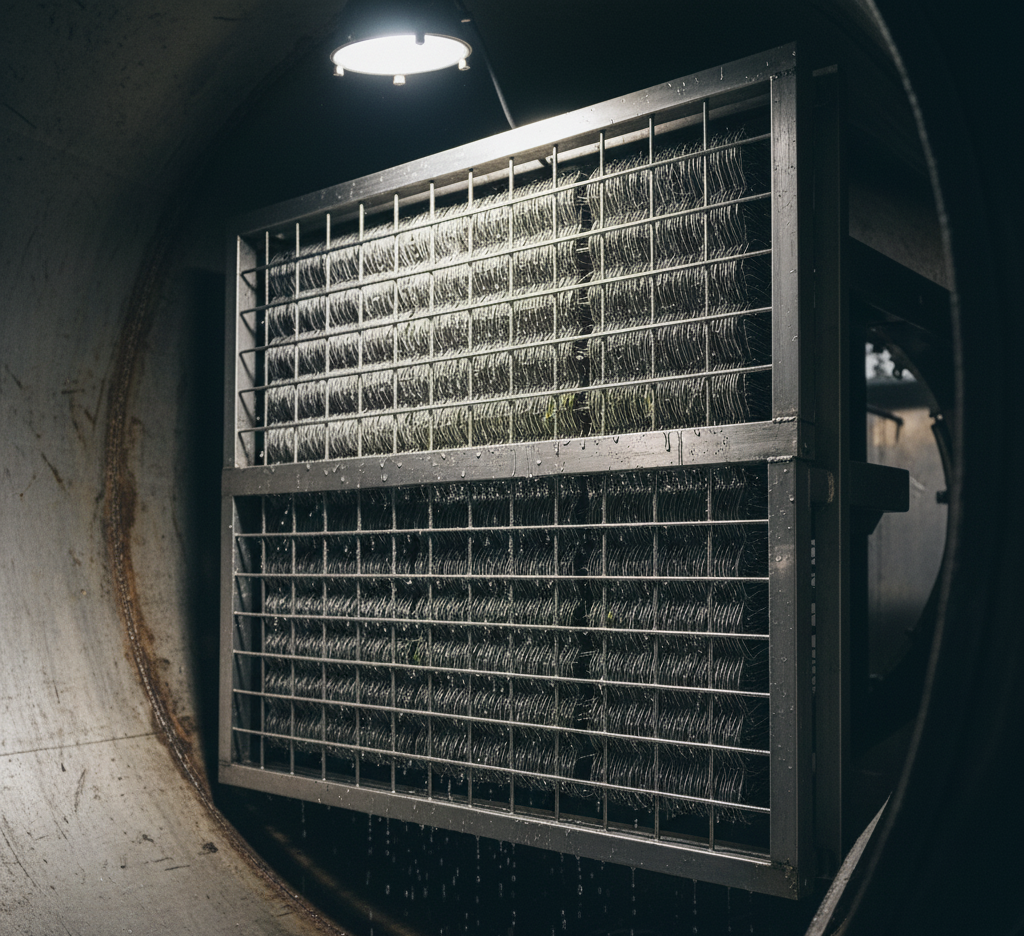
Liquid carryover remains a recurring issue in wet scrubbers, absorbers, sulfuric acid plants, chemical processing facilities, and industrial gas treatment systems. Entrained droplets that pass beyond the separation zone are a known source of downstream fouling, corrosion, product contamination, and increased maintenance frequency.
A mist eliminator is the final control element in many gas–liquid separation systems. Its function is straightforward in principle—remove entrained liquid aerosols before discharge—but its performance is highly dependent on process conditions. Engineers evaluate mist eliminator systems based on gas velocity, droplet size distribution, liquid loading, and vessel geometry, rather than relying solely on nominal efficiency ratings.
At Kimre™ Clean Air Technology, mist elimination is treated as a fluid dynamics and separation engineering problem. Effective performance depends on the interaction between collection media structure, droplet behavior, and drainage capacity under continuous industrial operation.
Why Mist Eliminator Selection Is a Process Decision
Mist eliminator performance directly influences emissions compliance, equipment integrity, and overall process stability. When separation systems are not properly matched to operating conditions, liquid carryover can propagate through the system and affect multiple downstream assets.
Common consequences of poor mist eliminator selection include:
- Elevated pressure drop
- Downstream heat exchanger and duct fouling
- Accelerated corrosion of equipment surfaces
- Reduced scrubber or absorber efficiency
- Increased maintenance intervals
- Elevated emissions variability
For this reason, mist eliminator selection is treated as a process design function rather than a discrete equipment purchase.
Fundamentals of Mist Eliminator Performance
A mist eliminator removes entrained droplets through a combination of inertial impaction, interception, coalescence, and gravitational drainage. As gas passes through the separation media, droplets are captured on collection surfaces, merge into larger droplets, and drain away from the gas stream.
Stable performance depends on maintaining balance between:
- Adequate gas velocity for effective capture
- Controlled pressure drop across the media
- Efficient liquid drainage pathways
- Resistance to re-entrainment under variable loading
When gas velocity exceeds the hydraulic design envelope, re-entrainment becomes more likely, reducing overall separation efficiency even if the media remains structurally intact.
Droplet Coalescence and Drainage Behavior
Coalescence is central to mist eliminator performance. Fine aerosols must be converted into larger droplets to enable effective drainage and separation.
Coalescence efficiency is governed by:
- Effective surface area of the collection media
- Media wettability and surface energy characteristics
- Flow path tortuosity and impingement frequency
- Liquid loading rate and distribution
- Drainage channel effectiveness
If drainage pathways become restricted, localized flooding can occur. In such conditions, separation efficiency may degrade even without visible damage to the mist eliminator element.
Evaluating Mist Eliminator System Types
Selection of a mist eliminator depends on process conditions, aerosol characteristics, and maintenance philosophy. Common technologies include mesh pads, fiber bed systems, and vane separators, each with distinct operating envelopes.
- Mesh Mist Eliminators
Knitted wire mesh mist eliminators provide high surface area for droplet capture and are widely used in general service applications. They perform effectively in relatively clean gas streams with moderate liquid loading. However, they can be susceptible to fouling in systems containing solids or sticky aerosols.
- Fiber Bed Mist Eliminators
Fiber bed mist eliminators are typically applied where high droplet capture efficiency is required, particularly for fine aerosols and submicron mist. These systems are commonly specified in sulfuric acid plants, chemical processing units, and other demanding mist elimination applications where high efficiency and stable long-term performance are required.
- Vane-Type Separators
Vane separators rely on directional flow changes and engineered drainage channels. They are generally more tolerant of higher liquid loading and can be advantageous in systems where fouling resistance is a primary concern.
Each technology must be evaluated within the context of process conditions rather than generic performance expectations.
Key Design and Implementation Considerations
Mist eliminator performance is strongly influenced by system-level design rather than media selection alone. Engineers evaluate the following parameters:
- Gas flow distribution and velocity profile
- Inlet momentum and turbulence levels
- Liquid loading and droplet spectrum
- Available free area within the vessel
- Drainage clearance and flow paths
- Allowable pressure drop
- Vessel geometry and internals layout
- Inspection and maintenance access
Even high-efficiency mist eliminator media can underperform when flow maldistribution or localized velocity spikes are present.
Retrofitting Existing Mist Eliminator Systems
Retrofit applications introduce additional constraints that must be evaluated during design. Existing vessels often limit available installation space, drainage geometry, and structural support options.
Key retrofit considerations include:
- Inlet and outlet flow conditioning
- Spray and distribution systems
- Support grids and structural constraints
- Drain system capacity and routing
- Access for installation and maintenance
- Existing flow maldistribution patterns
A successful retrofit depends on integrating new mist eliminator technology within the hydraulic and mechanical constraints of the existing system, rather than treating it as a direct replacement exercise.
Common Mist Eliminator Selection Errors
Many mist elimination performance issues originate from incomplete process characterization rather than equipment limitations.
Frequent evaluation errors include:
- Over-reliance on nominal efficiency ratings
- Underestimation of liquid loading variability
- Limited consideration of maintenance accessibility
- Insufficient review of process chemistry impacts
- Failure to account for operational transients
- Lack of lifecycle performance evaluation
A robust selection process considers both steady-state and off-design operating conditions.
Material Compatibility in Mist Elimination Service
Material selection is a critical factor in long-term mist eliminator performance. Process conditions often include combinations of acids, solvents, salts, surfactants, and elevated temperatures.
Material degradation mechanisms may include:
- Chemical attack from acidic or caustic species
- Stress corrosion cracking in metallic components
- Polymer degradation under thermal cycling
- Fouling from condensable species
Proper material selection supports sustained separation efficiency and reduces the risk of premature system failure.
Maintenance and Long-Term Performance
Mist eliminator systems perform most effectively when supported by defined maintenance strategies. Long-term reliability depends on monitoring system conditions and addressing fouling or flow degradation before performance loss occurs.
Typical maintenance practices include:
- Differential pressure monitoring across the system
- Scheduled inspection intervals
- Cleaning and wash-down procedures
- Drain system verification
- Performance trending over time
Unexpected increases in pressure drop often indicate fouling, flooding, or changes in flow distribution that require corrective action.
Cleaning Strategy and Operational Control
Cleaning protocols must be designed to balance performance recovery with media integrity. Excessive cleaning can damage sensitive collection media, while insufficient cleaning can lead to irreversible fouling.
Effective programs define:
- Inspection criteria and acceptance thresholds
- Approved cleaning methods and media compatibility
- Cleaning frequency based on operating data
- Post-cleaning performance verification
A controlled maintenance approach helps preserve mist eliminator efficiency while minimizing operational disruption.
Supporting Reliable Mist Elimination Performance
Effective mist elimination requires integration of droplet capture efficiency, coalescence behavior, hydraulic design, material compatibility, and maintenance strategy. Performance is determined not by media selection alone, but by how well the system matches real operating conditions.
Kimre™ Clean Air Technology applies decades of experience in Fiber Bed filtration, coalescing media, and industrial mist eliminator systems to complex aerosol control applications. Through engineering-based selection and application-specific design, facilities can improve equipment protection, maintain stable operation, and support long-term emissions compliance.

