
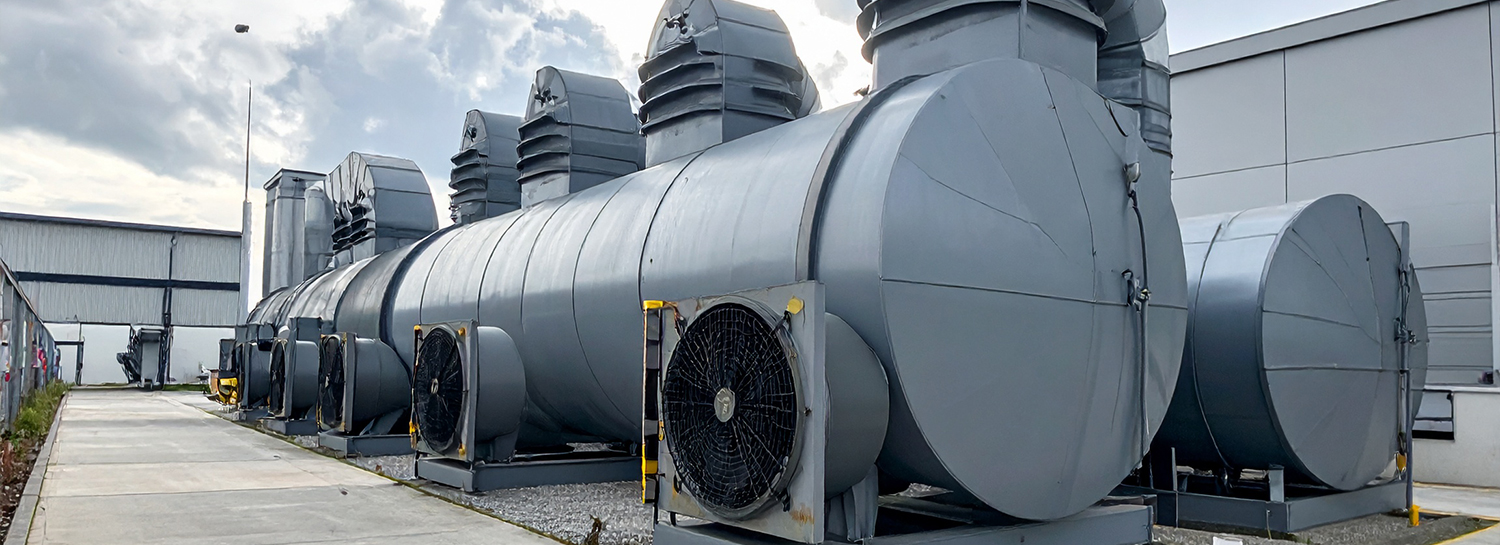
Nitric acid service does not tolerate approximation. Process vents from absorption columns, concentrators, and downstream handling steps carry a mixed phase burden—NOₓ (principally NO and NO₂), nitric acid vapor, and a persistent aerosol fraction. A properly engineered nitric acid scrubber, or nitric acid fume scrubber, is designed to impose control on that stream before discharge, not merely dilute it.
It functions as a defined mass transfer operation with known limitations—particularly with respect to nitric oxide.
What Is a Nitric Acid Fume Scrubber?
A nitric acid fume scrubber is a gas treatment system designed to remove nitrogen oxides, acid vapors, and fine nitric acid mist generated during nitric acid production and handling. In contrast to general wet scrubbers, a nitric acid scrubber system must operate under strongly oxidizing, low-pH conditions while maintaining performance against submicron aerosols.
This dual requirement, gas absorption and aerosol capture, drives the use of high-efficiency internals and downstream separation stages. The distinction becomes critical in fertilizer service, where mist eliminators for ammonium nitrate prilling towers are required to control both emissions and product loss.
How a Nitric Acid Scrubber System Operates
The governing mechanism is gas liquid mass transfer, with optional enhancement through oxidation or neutralization chemistry depending on system design.
The gas stream is distributed through a packed or structured section to maximize interfacial area. A scrubbing liquid water or an alkaline solution is applied to establish continuous contact.
Within this region:
- NO₂ and nitric acid vapor are readily absorbed into the liquid phase
- NO absorption is limited by low solubility unless pre-oxidized to NO₂
- Liquid-phase reactions may convert absorbed species to nitrate or nitrite, depending on chemistry
For this reason, high-efficiency nitric acid fume scrubber systems often incorporate:
- Oxidation steps (intentional or residence-time driven)
- Multi-stage contact to improve overall removal efficiency
No single stage should be assumed to achieve full NOₓ removal under variable plant conditions.
The Role of Mist Eliminators in Nitric Acid Service
Absorption alone does not resolve the aerosol fraction. Nitric acid mist often in the submicron range, passes through packed beds with minimal capture unless specifically addressed.
A nitric acid scrubber therefore requires a dedicated mist elimination stage to remove entrained droplets via:
- Interception
- Inertial impaction
- Brownian diffusion (for the smallest particles)
This is particularly critical in fertilizer production. Mist eliminators for ammonium nitrate prilling towers are used to capture fine particulate and acid mist exiting the tower, reducing visible plume, minimizing product loss, and stabilizing downstream emissions.
In this context, mist eliminators for ammonium nitrate prilling towers are performance-critical equipment, not auxiliary components.
Principal Components of a Nitric Acid Scrubber
A properly designed nitric acid scrubber system includes:
- Gas inlet and distribution system to prevent channeling
- Packed bed or structured media for gas–liquid contact
- Liquid distribution system ensuring uniform wetting
- Recirculation loop with controlled chemistry (pH, oxidation state)
- High-efficiency mist elimination stage for final aerosol removal
Material selection must reflect continuous exposure to nitric acid and oxidizing conditions—fluoropolymers, specialty alloys, and composite materials are standard.
Mechanisms of Hazardous Emission Control
A nitric acid fume scrubber reduces emissions through three concurrent mechanisms:
- Absorption of NO₂ and acid vapors into the liquid phase
- Limited chemical conversion, depending on oxidation conditions and scrubbing chemistry
- Mechanical separation of entrained droplets using mist eliminators
It is important to distinguish that:
- NO₂ removal is efficient and predictable
- NO removal is conditional, often requiring oxidation to achieve high overall NOₓ reduction
Systems that do not account for this distinction tend to underperform in practice.
Factors Influencing Scrubber Efficiency
The performance of a nitric acid scrubber is governed by:
- Gas flow rate and temperature (affecting solubility and kinetics)
- Liquid-to-gas ratio
- Packing type and effective surface area
- Scrubbing liquid composition and control strategy
- Efficiency of mist elimination, particularly for submicron droplets
Deviation from design conditions will directly affect removal efficiency and operational stability.
Operational Benefits Beyond Compliance
A well-executed nitric acid fume scrubber system does more than meet emission limits. By removing acid vapor and mist, it reduces corrosion in downstream equipment, stabilizes induced draft systems, and improves overall plant reliability.
In fertilizer applications, mist eliminators for ammonium nitrate prilling towers also reduce particulate loss and visible emissions, contributing to both process efficiency and environmental performance.
Engineering Discipline Defines Performance
A nitric acid scrubber performs in accordance with its design assumptions—no better. Effective systems reflect alignment between reaction chemistry, mass transfer constraints, and materials of construction.
Kimre Clean Air technology offers a unique approach, integrating fiber bed technology and high-efficiency mist eliminators for ammonium nitrate prilling towers, addresses both vapor-phase absorption and aerosol control under sustained industrial conditions. The objective is consistent, measurable emission reduction across real operating ranges.

