
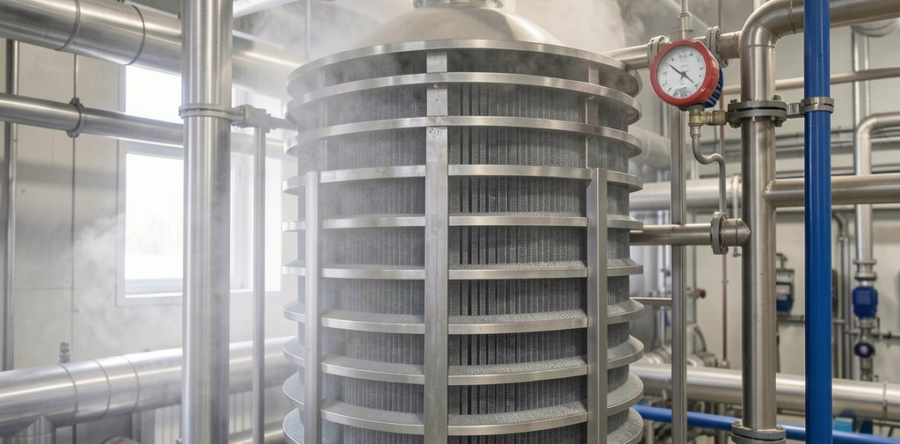
Process facilities operating in chemical, petrochemical, and power generation environments routinely handle gas and vapor streams containing entrained liquid droplets. While these droplets may exist at low concentrations, uncontrolled liquid carryover can significantly degrade process efficiency, accelerate equipment corrosion, and create environmental and regulatory risk. As operating conditions increase in severity and emissions limits become more restrictive, the role of the mist eliminator has become increasingly critical in industrial process design.
Industrial mist eliminators serve as essential separation devices, removing entrained liquid aerosols before gas streams migrate downstream or are discharged to the atmosphere. From chemical reactors and refinery fractionation towers to power plant wet scrubbers, mist elimination systems form a foundational layer of equipment protection, emissions control, and operational reliability.
What Is a Mist Eliminator and How Does It Function?
A mist eliminator is a mechanical separation device designed to remove entrained liquid droplets from gas or vapor streams. As the gas passes through engineered separation media—such as wire mesh pads, vane packs, or fiber bed structures—the liquid droplets impinge on internal surfaces, coalesce into larger droplets, and drain from the system under gravity. The treated gas exits with significantly reduced liquid content.
Depending on application requirements, the separation media may function as a high-efficiency mist eliminator filter, capable of capturing fine and submicron aerosols under controlled pressure drop conditions.
Operational Risks Associated with Liquid Carryover
Liquid carryover introduces multiple operational challenges across process industries. Entrained droplets can foul heat exchangers, contaminate downstream process streams, and accelerate corrosion in ducting and rotating equipment. In emissions control applications, inadequate mist removal can result in visible plumes, stack liquid discharge, and non-compliance with environmental regulations.
Properly engineered industrial mist eliminators mitigate these risks by providing predictable and repeatable liquid separation performance.
Mist Eliminator Applications in Chemical Processing Facilities
Chemical processing plants utilize mist eliminators in reactors, absorbers, distillation columns, evaporators, and process vent systems. These applications frequently involve corrosive vapors, solvents, or acidic aerosols that must be removed to protect compressors, downstream separation units, and catalytic processes. The selection of the appropriate mist eliminator filter is critical to maintaining consistent product quality and stable operation.
Experienced mist eliminator manufacturers design systems to withstand chemically aggressive environments while maintaining high separation efficiency over extended operating cycles.
Use of Mist Eliminators in Petrochemical Operations
In petrochemical refining and processing facilities, mist eliminators are installed in fractionation columns, sulfur recovery units, amine treating systems, and hydrocarbon processing units. These systems prevent hydrocarbon mist, aqueous droplets, and acid gas aerosols from migrating into downstream equipment or contaminating product streams.
Leading mist eliminator suppliers engineer solutions capable of operating under elevated temperatures, variable gas velocities, and high liquid loading conditions typical of petrochemical service.
Power Plant Applications of Mist Eliminators
Power generation facilities rely on mist eliminators in flue gas desulfurization systems, wet scrubbers, cooling tower exhausts, and steam vent applications. In wet flue gas environments, mist eliminators capture acidic droplets that would otherwise damage induced draft fans, ductwork, and stack linings.
High-performance industrial mist eliminators are essential for maintaining system availability while ensuring compliance with emissions regulations.
Role of Mist Eliminators in Wet Scrubber Systems
Within wet scrubber systems, the mist eliminator functions as the final separation stage following gas-liquid contact. After contaminants are absorbed or neutralized, residual droplets are removed prior to gas discharge. High-efficiency mist eliminator filters are designed to maintain performance under fluctuating flow conditions, minimizing liquid carryover and chemical loss.
Mist Eliminator Technologies Used Across Industries
Common mist eliminator configurations include wire mesh pads for bulk droplet removal, vane-style mist eliminators for high-velocity gas streams, and fiber bed mist eliminators for fine and submicron aerosol capture. Technology selection depends on droplet size distribution, gas velocity, liquid loading, allowable pressure drop, and required removal efficiency.
Many mist eliminator manufacturers provide customized designs to align with application-specific performance requirements.
Material Selection for Severe Service Applications
Material selection directly impacts the performance and service life of a mist eliminator. Stainless steels, high-nickel alloys, fluoropolymers, and fiberglass-reinforced plastics are selected based on corrosion resistance, temperature tolerance, and chemical compatibility. Experienced mist eliminator suppliers support material selection to ensure durability under severe operating conditions.
Equipment Protection and Plant Reliability Benefits
By removing entrained liquid droplets, industrial mist eliminators reduce fouling, erosion, and corrosion in downstream equipment. This protection extends maintenance intervals, improves operational stability, and reduces unplanned outages, contributing to improved overall plant reliability.
Emissions Control and Regulatory Compliance
Effective mist elimination supports compliance with environmental regulations by minimizing liquid emissions and visible plume formation. Properly designed mist eliminator systems enable facilities to meet air quality standards while reducing wastewater generation and chemical loss.
Common Performance Challenges in Mist Eliminator Applications
Mist eliminator performance issues may arise from improper sizing, fouling, excessive pressure drop, or incompatible materials. Addressing these challenges requires accurate process data, application-specific design, and periodic inspection to maintain long-term separation efficiency.
Best Practices for Selecting Mist Eliminators
Successful selection of a mist eliminator involves evaluation of droplet size, gas velocity, chemical exposure, maintenance accessibility, and lifecycle cost considerations. Collaboration with experienced mist eliminator manufacturers and mist eliminator suppliers ensures systems are engineered for sustained, reliable performance.
Importance of Mist Eliminators in Industrial Process Design
Mist eliminators are essential for controlling liquid carryover, protecting equipment, and maintaining regulatory compliance across chemical, petrochemical, and power generation facilities. Whether applied as a vane separator, wire mesh pad, or high-efficiency mist eliminator filter, each system plays a direct role in sustaining process efficiency and plant reliability.
With decades of experience in high-performance separation technologies, Kimre Clean Air Technology is a trusted mist eliminator manufacturer and supplier, delivering engineered industrial mist eliminators tailored to chemical, petrochemical, and power generation applications. Contact Kimre to evaluate separation challenges and implement systems designed for long-term operational performance and compliance.

